
Ch. 3 - Probability
Larson - Elementary Statistics: Picturing the World 8th Edition
Larson8th EditionElementary Statistics: Picturing the WorldISBN: 9780137493470Non è quello che usi tu?Cambia libro di testo
Capitolo 3, Problema 3.2.27b

"Using the Multiplication Rule In Exercises 19-32, use the Multiplication Rule.
27. Blood Types The probability that a person of Asian descent in the United States has type O+ blood is 39%. At random, six people of Asian descent in the United States are selected. (Source: American National Red Cross)
b. Find the probability that none of the six have type O+ blood."

Guida verificata passo dopo passo
1
Step 1: Understand the problem. We are tasked with finding the probability that none of the six randomly selected people of Asian descent have type O+ blood. The probability of a person having type O+ blood is given as 39%, or 0.39.
Step 2: Define the complement probability. The complement of a person having type O+ blood is the probability that they do not have type O+ blood. This is calculated as 1 - 0.39 = 0.61.
Step 3: Use the Multiplication Rule. Since the six people are selected independently, the probability that none of them have type O+ blood is the product of the complement probability for each individual. This can be expressed as \( P(\text{none have O+}) = (0.61)^6 \).
Step 4: Write the general formula. The general formula for this type of problem is \( P(\text{none have O+}) = (1 - p)^n \), where \( p \) is the probability of having type O+ blood (0.39 in this case), and \( n \) is the number of people selected (6 in this case).
Step 5: Substitute the values into the formula. Substitute \( p = 0.39 \) and \( n = 6 \) into the formula to calculate \( P(\text{none have O+}) = (1 - 0.39)^6 = (0.61)^6 \).

Risposta video verificata per un problema simile:

Questa soluzione video è stata consigliata dai nostri tutor come utile per risolvere questo problema.
Durata del video:
2m

Concetti chiave

Ecco i concetti essenziali che devi comprendere per rispondere correttamente alla domanda.

Multiplication Rule

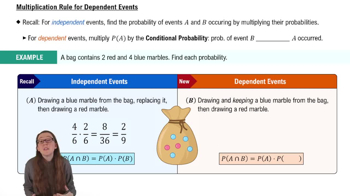
The Multiplication Rule in probability states that the probability of two independent events occurring together is the product of their individual probabilities. In this context, it is used to calculate the likelihood of multiple events happening simultaneously, such as selecting individuals with a specific blood type. For independent events, this rule simplifies the calculation of combined probabilities.
Video consigliato:
Percorso guidato
05:17
Multiplication Rule: Dependent Events

Independent Events

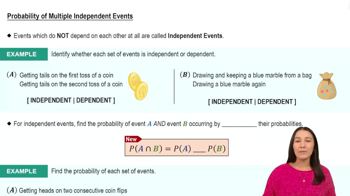
Independent events are those whose outcomes do not affect each other. In the given problem, the selection of one person does not influence the blood type of another selected person. Understanding that the events are independent allows us to apply the Multiplication Rule effectively to find the overall probability of multiple individuals not having type O+ blood.
Video consigliato:
Percorso guidato
05:54
Probability of Multiple Independent Events

Complementary Probability

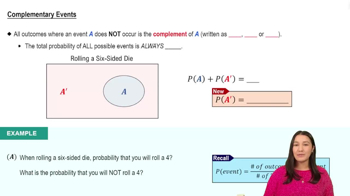
Complementary probability refers to the likelihood of an event not occurring, which is calculated as 1 minus the probability of the event occurring. In this scenario, to find the probability that none of the six selected individuals have type O+ blood, we first determine the probability that one person does not have type O+ blood and then apply the Multiplication Rule to find the combined probability for all six individuals.
Video consigliato:
Percorso guidato
4:23
Complementary Events
Pratica correlata
Domanda del libro di testo

25. Working from Home The table shows the results of a survey that asked 1811 people how often they work from home. A person is selected at random from the sample. Find the probability of each event.

b. The person is female or does not work from home.

" style="" width="400">

85
views
Domanda del libro di testo

"Using the Multiplication Rule In Exercises 19-32, use the Multiplication Rule.

25. Best President In a sample of 1500 adult U.S. citizens, 270 said that Barack Obama was the best president in U.S. history. Two adult U.S. citizens are selected at random.

(Adapted from YouGov)

b. Find the probability that neither adult U.S. citizen says that Barack Obama was the best president in U.S. history."

50
views
Domanda del libro di testo

"Using the Multiplication Rule In Exercises 19-32, use the Multiplication Rule.

25. Best President In a sample of 1500 adult U.S. citizens, 270 said that Barack Obama was the best president in U.S. history. Two adult U.S. citizens are selected at random.

(Adapted from YouGov)

c. Find the probability that at least one of the two adult U.S. citizens says that Barack Obama was the best president in U.S. history."

42
views
Domanda del libro di testo

19. U.S. Age Distribution The projected percent distribution of the U.S. population for 2025 is shown in the pie chart. Find the probability of each event. (Source: U.S. Census

Bureau)

c. Randomly selecting someone who is not 60 years or over

186
views
Domanda del libro di testo

Politics The responses of 1500 U.S. adults to a survey that asked them to state their own political viewpoints are shown in the Pareto chart. Find the probability of each event.(Adapted from YouGov)

b. Randomly selecting a person from the sample who is conservative or very conservative

91
views
Domanda del libro di testo

88. Individual Stock Price An individual stock is selected at random from the portfolio represented by the box-and-whisker plot shown. Find the probability that the stock price is between \$21 and \$50.

82
views