
Ch. 3 - Probability
Larson - Elementary Statistics: Picturing the World 8th Edition
Larson8th EditionElementary Statistics: Picturing the WorldISBN: 9780137493470Non è quello che usi tu?Cambia libro di testo
Capitolo 3, Problema 3.4.53

Warehouse In Exercises 51-54, a warehouse employs 24 workers on first shift, 17 workers on second shift, and 13 workers on third shift. Eight workers are chosen at random to be
interviewed about the work environment.
Find the probability of choosing four third-shift workers.

Guida verificata passo dopo passo
1
Step 1: Identify the total number of workers in the warehouse. Add the workers from all shifts: 24 (first shift) + 17 (second shift) + 13 (third shift). This gives the total population size (N).
Step 2: Determine the number of workers on the third shift (k), which is 13, and the total number of workers to be chosen (n), which is 8.
Step 3: Use the hypergeometric probability formula to calculate the probability of choosing exactly 4 third-shift workers. The formula is: P(X = x) = (C(k, x) * C(N-k, n-x)) / C(N, n), where C(a, b) represents the combination formula a! / (b!(a-b)!).
Step 4: Substitute the values into the formula. Here, k = 13, N = 54, n = 8, and x = 4. Compute the combinations: C(13, 4) for selecting 4 third-shift workers, C(41, 4) for selecting the remaining 4 workers from the other shifts, and C(54, 8) for selecting any 8 workers from the total population.
Step 5: Simplify the expression by calculating each combination and dividing the result of the numerator by the denominator. This will give the probability of choosing exactly 4 third-shift workers.

Risposta video verificata per un problema simile:

Questa soluzione video è stata consigliata dai nostri tutor come utile per risolvere questo problema.
Durata del video:
4m

Concetti chiave

Ecco i concetti essenziali che devi comprendere per rispondere correttamente alla domanda.

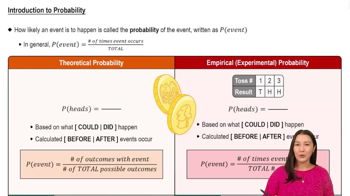
Probability

Probability is a measure of the likelihood that a particular event will occur, expressed as a number between 0 and 1. In this context, it involves calculating the chance of selecting a specific number of third-shift workers from a total group of workers. Understanding how to compute probabilities is essential for solving problems related to random selection.
Video consigliato:
Percorso guidato
5:37
Introduction to Probability

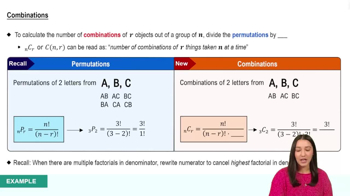
Combinations

Combinations refer to the selection of items from a larger set where the order does not matter. In this scenario, we need to determine how many ways we can choose four third-shift workers from the total number of third-shift workers available. The formula for combinations is crucial for calculating the total possible selections.
Video consigliato:

Total Workers and Distribution

Understanding the total number of workers and their distribution across shifts is vital for calculating probabilities. In this case, there are 54 workers in total (24 first shift, 17 second shift, and 13 third shift). This distribution helps in determining the total number of ways to select workers and the specific group of interest (third-shift workers).
Video consigliato:
Percorso guidato
06:38
Intro to Frequency Distributions