
Ch. 3 - Probability
Larson - Elementary Statistics: Picturing the World 8th Edition
Larson8th EditionElementary Statistics: Picturing the WorldISBN: 9780137493470Non è quello che usi tu?Cambia libro di testo
Capitolo 3, Problema 3.4.12

In Exercises 7-14, perform the indicated calculation.
12. (10C7)/(14C7)

Guida verificata passo dopo passo
1
Step 1: Understand the problem. The problem involves calculating a ratio of combinations. Specifically, we need to compute \( \frac{{10C7}}{{14C7}} \), where \( nCk \) represents the number of combinations of \( k \) items chosen from \( n \) items.
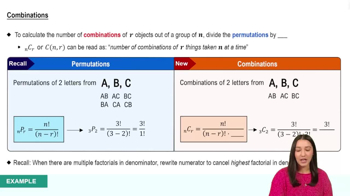
Step 2: Recall the formula for combinations. The formula for \( nCk \) is given by \( nCk = \frac{{n!}}{{k!(n-k)!}} \), where \( n! \) is the factorial of \( n \).
Step 3: Apply the formula to calculate \( 10C7 \). Substitute \( n = 10 \) and \( k = 7 \) into the formula: \( 10C7 = \frac{{10!}}{{7!(10-7)!}} = \frac{{10!}}{{7! \cdot 3!}} \).
Step 4: Apply the formula to calculate \( 14C7 \). Substitute \( n = 14 \) and \( k = 7 \) into the formula: \( 14C7 = \frac{{14!}}{{7!(14-7)!}} = \frac{{14!}}{{7! \cdot 7!}} \).
Step 5: Simplify the ratio \( \frac{{10C7}}{{14C7}} \). Substitute the expressions for \( 10C7 \) and \( 14C7 \) into the ratio and simplify by canceling common terms. This will give the final result.

Risposta video verificata per un problema simile:

Questa soluzione video è stata consigliata dai nostri tutor come utile per risolvere questo problema.
Durata del video:
4m

Concetti chiave

Ecco i concetti essenziali che devi comprendere per rispondere correttamente alla domanda.

Combinations

Combinations refer to the selection of items from a larger set where the order of selection does not matter. The notation 'nCr' represents the number of ways to choose 'r' items from 'n' items, calculated using the formula n! / (r!(n-r)!), where '!' denotes factorial. Understanding combinations is essential for solving problems involving groups or selections.
Video consigliato:

Factorial

A factorial, denoted as 'n!', is the product of all positive integers up to 'n'. For example, 5! = 5 × 4 × 3 × 2 × 1 = 120. Factorials are fundamental in combinatorial calculations, as they help determine the total arrangements or selections of items, making them crucial for understanding combinations.
Video consigliato:

Ratio of Combinations

The ratio of combinations compares two different combinations, providing insight into their relative sizes. In the expression (10C7)/(14C7), it calculates how many ways you can choose 7 items from 10 compared to choosing 7 from 14. This concept is useful in probability and statistics for understanding the likelihood of different outcomes.
Video consigliato: