Ch. 5 - Normal Probability Distributions
Larson - Elementary Statistics: Picturing the World 8th Edition
Larson8th EditionElementary Statistics: Picturing the WorldISBN: 9780137493470Non è quello che usi tu?Cambia libro di testo
Capitolo 5, Problema 5.5.10

In Exercises 9–14, write the binomial probability in words. Then, use a continuity correction to convert the binomial probability to a normal distribution probability.


P(x ≥ 110)

Guida verificata passo dopo passo
1
Step 1: Write the binomial probability in words. The problem asks for the probability that the random variable X is greater than or equal to 110. In words, this means 'the probability that the number of successes is at least 110.'
Step 2: Recall that a binomial distribution can be approximated by a normal distribution when the sample size is large and both np and n(1-p) are greater than or equal to 5. Verify these conditions for the given problem.
Step 3: Apply the continuity correction. Since the binomial distribution is discrete and the normal distribution is continuous, adjust the boundary for P(x ≥ 110) to P(x ≥ 109.5) in the normal distribution.
Step 4: Standardize the value using the z-score formula for a normal distribution: z = (x - μ) / σ, where μ = np (mean) and σ = √(np(1-p)) (standard deviation). Substitute the values of n (sample size), p (probability of success), and x = 109.5 into the formula.
Step 5: Use the standard normal distribution table or a statistical software to find the probability corresponding to the calculated z-score. This will give the approximate probability for the binomial distribution using the normal approximation.

Risposta video verificata per un problema simile:

Questa soluzione video è stata consigliata dai nostri tutor come utile per risolvere questo problema.
Durata del video:
2m

Concetti chiave

Ecco i concetti essenziali che devi comprendere per rispondere correttamente alla domanda.

Binomial Probability

Binomial probability refers to the likelihood of obtaining a fixed number of successes in a fixed number of independent Bernoulli trials, each with the same probability of success. It is calculated using the binomial formula, which incorporates the number of trials, the number of successes, and the probability of success. In this context, P(x ≥ 110) represents the probability of achieving 110 or more successes.
Video consigliato:
Percorso guidato
06:39
Calculating Probabilities in a Binomial Distribution

Normal Distribution

The normal distribution is a continuous probability distribution characterized by its bell-shaped curve, defined by its mean and standard deviation. It is often used to approximate the binomial distribution when the number of trials is large, due to the Central Limit Theorem. This approximation allows for easier calculations of probabilities, especially when dealing with large sample sizes.
Video consigliato:
Percorso guidato
06:23
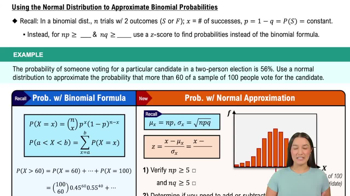
Using the Normal Distribution to Approximate Binomial Probabilities

Continuity Correction

Continuity correction is a technique used when approximating a discrete probability distribution, like the binomial, with a continuous distribution, such as the normal distribution. It involves adjusting the discrete value by 0.5 to account for the fact that the normal distribution is continuous. For example, to find P(x ≥ 110) in a normal approximation, one would calculate P(x > 109.5) to ensure a more accurate representation of the binomial probability.
Video consigliato:
Percorso guidato
06:23
Using the Normal Distribution to Approximate Binomial Probabilities