
Ch. 6 - Confidence Intervals
Larson - Elementary Statistics: Picturing the World 8th Edition
Larson8th EditionElementary Statistics: Picturing the WorldISBN: 9780137493470Non è quello che usi tu?Cambia libro di testo
Capitolo 6, Problema 6.1.31

In Exercises 29–32, determine the minimum sample size n needed to estimate for the values of c, σ, and E.
c = 0.80, σ = 4.1, E = 2.

Guida verificata passo dopo passo
1
Identify the formula for determining the minimum sample size n for estimating a population mean: n = zc2σ2E2, where zc is the critical z-value, σ is the population standard deviation, and E is the margin of error.
Determine the critical z-value (zc) for the given confidence level c = 0.80. Use a z-table or statistical software to find the z-value corresponding to the middle 80% of the standard normal distribution.
Substitute the given values into the formula: c = 0.80, σ = 4.1, and E = 2. Replace zc with the critical z-value obtained in the previous step.
Simplify the numerator by squaring the critical z-value (zc) and multiplying it by the square of the population standard deviation (σ²).
Divide the result from the numerator by the square of the margin of error (E²) to calculate the minimum sample size n. Round up to the nearest whole number, as sample size must be an integer.

Risposta video verificata per un problema simile:

Questa soluzione video è stata consigliata dai nostri tutor come utile per risolvere questo problema.
Durata del video:
2m

Concetti chiave

Ecco i concetti essenziali che devi comprendere per rispondere correttamente alla domanda.

Sample Size Determination

Sample size determination is the process of calculating the number of observations or replicates needed in a statistical study to ensure that the results are reliable and valid. It is crucial for achieving a desired level of confidence and margin of error in estimates. The formula often used involves the population standard deviation, the desired confidence level, and the margin of error.
Video consigliato:
Percorso guidato
06:14
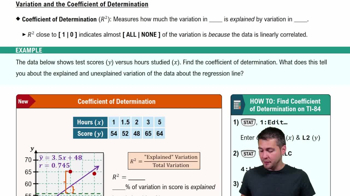
Coefficient of Determination

Confidence Level (c)

The confidence level represents the probability that the sample accurately reflects the population parameter within a specified margin of error. A confidence level of 0.80, for instance, indicates that if the same sampling procedure were repeated multiple times, approximately 80% of the intervals would contain the true population parameter. This concept is essential for understanding the reliability of the estimate.
Video consigliato:
Percorso guidato
06:33
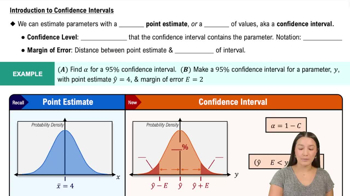
Introduction to Confidence Intervals

Margin of Error (E)

The margin of error is the range within which the true population parameter is expected to fall, given a certain confidence level. It quantifies the uncertainty associated with the sample estimate. A smaller margin of error requires a larger sample size, as it indicates a more precise estimate of the population parameter, which is critical for making informed decisions based on the data.
Video consigliato:
Percorso guidato
06:33
Introduction to Confidence Intervals