
Ch. 9 - Correlation and Regression
Larson - Elementary Statistics: Picturing the World 8th Edition
Larson8th EditionElementary Statistics: Picturing the WorldISBN: 9780137493470Non è quello che usi tu?Cambia libro di testo
Capitolo 9, Problema 9.1.4

4. Give examples of two variables that have perfect positive linear correlation and two variables that have perfect negative linear correlation.

Guida verificata passo dopo passo
1
Understand the concept of perfect positive linear correlation: This occurs when two variables increase or decrease together in a perfectly linear manner. The correlation coefficient (r) is +1.
Understand the concept of perfect negative linear correlation: This occurs when one variable increases while the other decreases in a perfectly linear manner. The correlation coefficient (r) is -1.
For perfect positive linear correlation, consider examples such as: (1) The distance traveled by a car and the time taken at a constant speed, or (2) The amount of money earned and the number of hours worked at a fixed hourly rate.
For perfect negative linear correlation, consider examples such as: (1) The speed of a car and the time taken to travel a fixed distance, or (2) The number of workers assigned to a task and the time required to complete the task (assuming constant efficiency).
Summarize the examples and ensure they align with the definitions of perfect positive and negative linear correlation, emphasizing the linear and deterministic relationship between the variables.

Risposta video verificata per un problema simile:

Questa soluzione video è stata consigliata dai nostri tutor come utile per risolvere questo problema.
Durata del video:
2m

Concetti chiave

Ecco i concetti essenziali che devi comprendere per rispondere correttamente alla domanda.

Perfect Positive Linear Correlation

Perfect positive linear correlation occurs when two variables move in the same direction with a consistent ratio. This means that as one variable increases, the other variable also increases proportionally. An example is the relationship between height and weight in a specific population, where taller individuals tend to weigh more.
Video consigliato:
Percorso guidato
05:43
Correlation Coefficient

Perfect Negative Linear Correlation

Perfect negative linear correlation exists when two variables move in opposite directions with a consistent ratio. In this case, as one variable increases, the other decreases proportionally. An example is the relationship between the speed of a car and the time taken to reach a destination, where higher speeds result in shorter travel times.
Video consigliato:
Percorso guidato
05:43
Correlation Coefficient

Correlation Coefficient

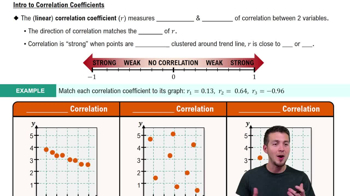
The correlation coefficient is a statistical measure that quantifies the strength and direction of a relationship between two variables. It ranges from -1 to 1, where 1 indicates perfect positive correlation, -1 indicates perfect negative correlation, and 0 indicates no correlation. Understanding this coefficient helps in assessing the degree of linear relationships between variables.
Video consigliato:
Percorso guidato
05:43
Correlation Coefficient