
Ch. 11 - Goodness-of-Fit and Contingency Tables
Triola - Elementary Statistics 14th Edition
Triola14th EditionElementary StatisticsISBN: 9780137366446Non è quello che usi tu?Cambia libro di testo
Capitolo 11, Problema 11.2.4

Right-Tailed, Left-Tailed, Two-Tailed Is the hypothesis test described in Exercise 1 right-tailed, left-tailed, or two-tailed? Explain your choice.

Guida verificata passo dopo passo
1
Understand the context of the hypothesis test: Determine whether the problem involves testing if a parameter is greater than, less than, or simply different from a specific value. This will guide the choice of tail direction.
Recall the definitions of the types of hypothesis tests: A right-tailed test is used when the alternative hypothesis (H₁) states that the parameter is greater than a specific value. A left-tailed test is used when H₁ states that the parameter is less than a specific value. A two-tailed test is used when H₁ states that the parameter is not equal to a specific value.
Examine the alternative hypothesis (H₁): Identify the inequality sign in H₁. If it uses '>', it is a right-tailed test. If it uses '<', it is a left-tailed test. If it uses '≠', it is a two-tailed test.
Consider the research question or claim being tested: The direction of the test depends on whether the claim is about an increase, a decrease, or simply a difference in the parameter being studied.
Conclude the type of test: Based on the inequality in H₁ and the context of the problem, classify the test as right-tailed, left-tailed, or two-tailed, and explain your reasoning clearly.

Risposta video verificata per un problema simile:

Questa soluzione video è stata consigliata dai nostri tutor come utile per risolvere questo problema.
Durata del video:
2m

Concetti chiave

Ecco i concetti essenziali che devi comprendere per rispondere correttamente alla domanda.

Hypothesis Testing

Hypothesis testing is a statistical method used to make decisions about a population based on sample data. It involves formulating a null hypothesis (H0) and an alternative hypothesis (H1), then using sample data to determine whether to reject H0 in favor of H1. The outcome helps in understanding if there is enough evidence to support a specific claim about the population.
Video consigliato:
Percorso guidato
06:21
Step 1: Write Hypotheses

One-Tailed vs. Two-Tailed Tests

In hypothesis testing, a one-tailed test evaluates the possibility of the relationship in one direction (either greater than or less than), while a two-tailed test assesses both directions. A right-tailed test looks for evidence that a parameter is greater than a certain value, whereas a left-tailed test checks if it is less. The choice between these tests depends on the research question and the nature of the hypothesis.
Video consigliato:
Percorso guidato
09:27
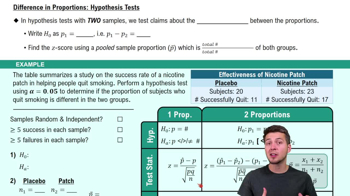
Difference in Proportions: Hypothesis Tests

Critical Region

The critical region in hypothesis testing is the set of all values of the test statistic that would lead to the rejection of the null hypothesis. For a right-tailed test, this region is located in the upper tail of the distribution, while for a left-tailed test, it is in the lower tail. In a two-tailed test, the critical regions are found in both tails, reflecting the possibility of extreme values in either direction.
Video consigliato:
Percorso guidato
05:50
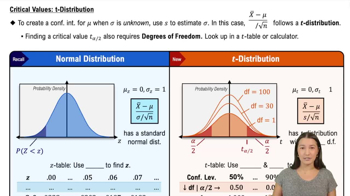
Critical Values: t-Distribution