Ch. 5 - Discrete Probability Distributions
Triola - Elementary Statistics 14th Edition
Triola14th EditionElementary StatisticsISBN: 9780137366446Non è quello che usi tu?Cambia libro di testo
Capitolo 5, Problema 5.2.13c

Binomial Probability Formula. In Exercises 13 and 14, answer the questions designed to help understand the rationale for the binomial probability formula.


Guessing Answers Standard tests, such as the SAT, ACT, or Medical College Admission Test (MCAT), typically use multiple choice questions, each with five possible answers (a, b, c, d, e), one of which is correct. Assume that you guess the answers to the first three questions.


c. Based on the preceding results, what is the probability of getting exactly one correct answer when three guesses are made?

Guida verificata passo dopo passo
1
Step 1: Recognize that this is a binomial probability problem. The binomial probability formula is given by: P(X = k) = (n choose k) * p^k * (1-p)^(n-k), where 'n' is the number of trials, 'k' is the number of successes, 'p' is the probability of success on a single trial, and '1-p' is the probability of failure.
Step 2: Identify the values for the problem. Here, 'n' (number of trials) is 3 because there are three questions, 'k' (number of successes) is 1 because we are looking for exactly one correct answer, and 'p' (probability of success) is 1/5 = 0.2 because there is one correct answer out of five choices.
Step 3: Calculate the binomial coefficient (n choose k), which is given by the formula: (n choose k) = n! / [k! * (n-k)!]. For this problem, (3 choose 1) = 3! / [1! * (3-1)!] = 3.
Step 4: Substitute the values into the binomial probability formula. Using the formula P(X = k) = (n choose k) * p^k * (1-p)^(n-k), substitute n = 3, k = 1, and p = 0.2. This gives: P(X = 1) = (3 choose 1) * (0.2)^1 * (1-0.2)^(3-1).
Step 5: Simplify the expression step by step. First, calculate (3 choose 1), then calculate (0.2)^1, and finally calculate (1-0.2)^2. Multiply these values together to find the probability of getting exactly one correct answer.

Risposta video verificata per un problema simile:

Questa soluzione video è stata consigliata dai nostri tutor come utile per risolvere questo problema.
Durata del video:
5m

Concetti chiave

Ecco i concetti essenziali che devi comprendere per rispondere correttamente alla domanda.

Binomial Probability Distribution

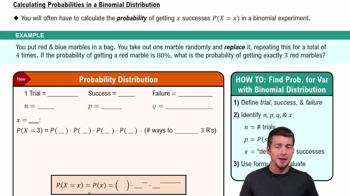
The binomial probability distribution models the number of successes in a fixed number of independent Bernoulli trials, each with the same probability of success. In this context, a 'success' is defined as correctly guessing an answer on a multiple-choice test. The formula for calculating the probability of exactly k successes in n trials is given by P(X = k) = (n choose k) * p^k * (1-p)^(n-k), where p is the probability of success on a single trial.
Video consigliato:
Percorso guidato
06:39
Calculating Probabilities in a Binomial Distribution

Probability of Success and Failure

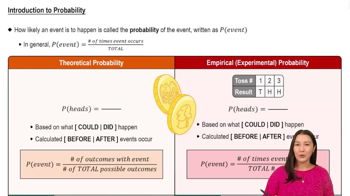
In the context of guessing answers on a multiple-choice test, the probability of success (correctly guessing an answer) is 1/5, since there is one correct answer out of five options. Conversely, the probability of failure (incorrectly guessing) is 4/5. Understanding these probabilities is crucial for applying the binomial formula to calculate the likelihood of achieving a specific number of correct answers.
Video consigliato:
Percorso guidato
5:37
Introduction to Probability

Combinatorial Coefficient

The combinatorial coefficient, often represented as 'n choose k' or C(n, k), calculates the number of ways to choose k successes from n trials. This is essential in the binomial probability formula, as it accounts for the different sequences in which successes and failures can occur. For example, if you want to find the probability of getting exactly one correct answer out of three guesses, you need to determine how many different ways this can happen.
Video consigliato:
Percorso guidato
05:43
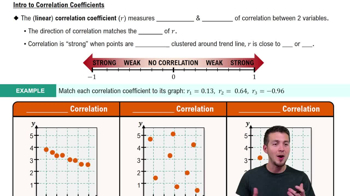
Correlation Coefficient
Pratica correlata
Domanda del libro di testo

Using Probabilities for Significant Events


c. Which probability is relevant for determining whether 3 is a significantly high number of matches: the result from part (a) or part (b)?

130
views

Domanda del libro di testo

Expected Value for the Florida Pick 3 Lottery In the Florida Pick 3 lottery, you can bet \$1 by selecting three digits, each between 0 and 9 inclusive. If the same three numbers are drawn in the same order, you win and collect \$500.


b. What is the probability of winning?


202
views
Domanda del libro di testo

Lottery. In Exercises 15–20, refer to the accompanying table, which describes probabilities for the California Daily 4 lottery. The player selects four digits with repetition allowed, and the random variable x is the number of digits that match those in the same order that they are drawn (for a “straight” bet).


Using Probabilities for Significant Events


b. Find the probability of getting 2 or more matches.


144
views
Domanda del libro di testo

Lottery. In Exercises 15–20, refer to the accompanying table, which describes probabilities for the California Daily 4 lottery. The player selects four digits with repetition allowed, and the random variable x is the number of digits that match those in the same order that they are drawn (for a “straight” bet).


Using Probabilities for Significant Events


b. Find the probability of getting 3 or more matches.

129
views
Domanda del libro di testo

Salary Negotiations In a Jobvite survey, 2287 adult workers were randomly selected and asked about salary negotiations.


b. Among those who negotiated salary, 84% received higher pay. How many received higher pay?


91
views
Domanda del libro di testo

In Exercises 25–28, find the probabilities and answer the questions.


Internet Voting Based on a Consumer Reports survey, 39% of likely voters would be willing to vote by Internet instead of the in-person traditional method of voting. For each of the following, assume that 15 likely voters are randomly selected.


c. Find the probability that at least one of the selected likely voters would do Internet voting.

163
views