Ch. 5 - Discrete Probability Distributions
Triola - Elementary Statistics 14th Edition
Triola14th EditionElementary StatisticsISBN: 9780137366446Non è quello che usi tu?Cambia libro di testo
Capitolo 5, Problema 5.1.18b

Lottery. In Exercises 15–20, refer to the accompanying table, which describes probabilities for the California Daily 4 lottery. The player selects four digits with repetition allowed, and the random variable x is the number of digits that match those in the same order that they are drawn (for a “straight” bet).
Table showing probabilities for matching digits in a lottery: 0.656 for 0, 0.292 for 1, 0.049 for 2, 0.004 for 3, 0+ for 4.


Using Probabilities for Significant Events


b. Find the probability of getting 2 or more matches.

Guida verificata passo dopo passo
1
Step 1: Understand the problem. We are tasked with finding the probability of getting 2 or more matches in the California Daily 4 lottery. This means we need to calculate the sum of probabilities for x = 2, x = 3, and x = 4.
Step 2: Refer to the provided table. The table lists the probabilities for different numbers of matching digits (x). Specifically, P(x=2) = 0.049, P(x=3) = 0.004, and P(x=4) = 0+.
Step 3: Add the probabilities for x = 2, x = 3, and x = 4. Use the formula: \( P(x \geq 2) = P(x=2) + P(x=3) + P(x=4) \). Substitute the values from the table into this formula.
Step 4: Perform the addition. Combine the probabilities: \( P(x \geq 2) = 0.049 + 0.004 + 0+ \). Note that the probability for x = 4 is effectively zero (0+).
Step 5: Interpret the result. The sum represents the probability of getting 2 or more matches in the lottery. This is the final probability value, which can be used to understand the likelihood of this event occurring.

Risposta video verificata per un problema simile:

Questa soluzione video è stata consigliata dai nostri tutor come utile per risolvere questo problema.
Durata del video:
2m

Concetti chiave

Ecco i concetti essenziali che devi comprendere per rispondere correttamente alla domanda.

Probability Distribution

A probability distribution describes how the probabilities of a random variable are distributed across its possible values. In this case, the table provides the probabilities for matching digits in the California Daily 4 lottery, indicating the likelihood of getting 0, 1, 2, 3, or 4 matches. Understanding this distribution is essential for calculating the probability of specific outcomes.
Video consigliato:
Percorso guidato
06:39
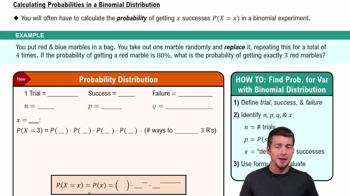
Calculating Probabilities in a Binomial Distribution

Cumulative Probability

Cumulative probability refers to the probability of a random variable being less than or equal to a certain value. To find the probability of getting 2 or more matches, one must calculate the cumulative probabilities for 0 and 1 matches and subtract them from 1. This concept is crucial for determining the likelihood of achieving at least a specified number of successes in a probability scenario.
Video consigliato:
Percorso guidato
5:37
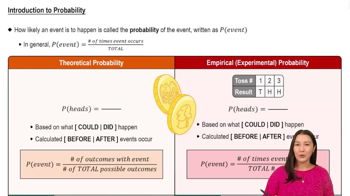
Introduction to Probability

Complement Rule

The complement rule in probability states that the probability of an event occurring is equal to 1 minus the probability of the event not occurring. In this context, to find the probability of getting 2 or more matches, we can use the complement rule by calculating the probabilities of getting 0 or 1 matches and subtracting their sum from 1. This simplifies the calculation and provides a clear method for solving the problem.
Video consigliato:
Percorso guidato
03:53
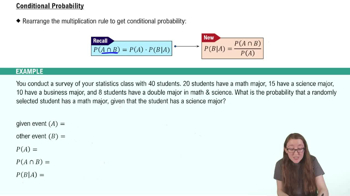
Conditional Probability Rule
Pratica correlata
Domanda del libro di testo

Using Probabilities for Significant Events


c. Which probability is relevant for determining whether 3 is a significantly high number of matches: the result from part (a) or part (b)?

130
views

Domanda del libro di testo

Binomial Probability Formula. In Exercises 13 and 14, answer the questions designed to help understand the rationale for the binomial probability formula.


Guessing Answers Standard tests, such as the SAT, ACT, or Medical College Admission Test (MCAT), typically use multiple choice questions, each with five possible answers (a, b, c, d, e), one of which is correct. Assume that you guess the answers to the first three questions.


c. Based on the preceding results, what is the probability of getting exactly one correct answer when three guesses are made?

310
views
Domanda del libro di testo

Expected Value for the Florida Pick 3 Lottery In the Florida Pick 3 lottery, you can bet \$1 by selecting three digits, each between 0 and 9 inclusive. If the same three numbers are drawn in the same order, you win and collect \$500.


b. What is the probability of winning?


202
views
Domanda del libro di testo

Lottery. In Exercises 15–20, refer to the accompanying table, which describes probabilities for the California Daily 4 lottery. The player selects four digits with repetition allowed, and the random variable x is the number of digits that match those in the same order that they are drawn (for a “straight” bet).


Using Probabilities for Significant Events


b. Find the probability of getting 3 or more matches.

129
views
Domanda del libro di testo

In Exercises 25–28, find the probabilities and answer the questions.


Too Young to Tat Based on a Harris poll, among adults who regret getting tattoos, 20% say that they were too young when they got their tattoos. Assume that five adults who regret getting tattoos are randomly selected, and find the indicated probability.


b. Find the probability that exactly one of the selected adults says that he or she was too young to get tattoos.


116
views
Domanda del libro di testo

Salary Negotiations In a Jobvite survey, 2287 adult workers were randomly selected and asked about salary negotiations.


b. Among those who negotiated salary, 84% received higher pay. How many received higher pay?


91
views