Ch. 8 - Hypothesis Testing
Triola - Elementary Statistics 14th Edition
Triola14th EditionElementary StatisticsISBN: 9780137366446Non è quello che usi tu?Cambia libro di testo
Capitolo 8, Problema 8.1.22

Final Conclusions
In Exercises 21–24, use a significance level of α = 0.05 and use the given information for the following:


State a conclusion about the null hypothesis. (Reject H0 or fail to reject H0.)
Without using technical terms or symbols, state a final conclusion that addresses the original claim


Original claim: More than 35% of air travelers would choose another airline to have access to inflight Wi-Fi. The hypothesis test results in a P-value of 0.00001.

Guida verificata passo dopo passo
1
Step 1: Identify the null hypothesis (H0) and the alternative hypothesis (H1). The null hypothesis (H0) is that 35% or fewer air travelers would choose another airline to have access to inflight Wi-Fi (p ≤ 0.35). The alternative hypothesis (H1) is that more than 35% of air travelers would choose another airline to have access to inflight Wi-Fi (p > 0.35).
Step 2: Compare the P-value to the significance level (α = 0.05). The P-value provided is 0.00001, which is much smaller than the significance level of 0.05.
Step 3: Based on the comparison, decide whether to reject or fail to reject the null hypothesis. Since the P-value is less than α, we reject the null hypothesis (H0).
Step 4: Translate the statistical conclusion into plain language. Rejecting the null hypothesis means there is sufficient evidence to support the claim that more than 35% of air travelers would choose another airline to have access to inflight Wi-Fi.
Step 5: Final conclusion: Based on the data and the hypothesis test, it can be concluded that more than 35% of air travelers would choose another airline to have access to inflight Wi-Fi.

Risposta video verificata per un problema simile:

Questa soluzione video è stata consigliata dai nostri tutor come utile per risolvere questo problema.
Durata del video:
5m

Concetti chiave

Ecco i concetti essenziali che devi comprendere per rispondere correttamente alla domanda.

Null Hypothesis (H0)

The null hypothesis is a statement that assumes no effect or no difference in a given situation. In this context, it posits that 35% or fewer air travelers would choose another airline for inflight Wi-Fi. Understanding the null hypothesis is crucial for determining whether the evidence supports or contradicts this claim.
Video consigliato:
Percorso guidato
06:21
Step 1: Write Hypotheses

P-value

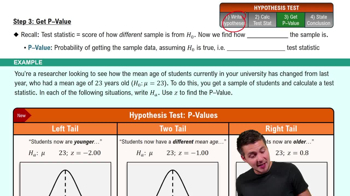
The P-value is a statistical measure that helps determine the strength of the evidence against the null hypothesis. A low P-value, such as 0.00001 in this case, indicates strong evidence that the null hypothesis may be rejected. This means that the observed data is highly unlikely under the assumption that the null hypothesis is true.
Video consigliato:
Percorso guidato
06:50
Step 3: Get P-Value

Significance Level (α)

The significance level, denoted as α, is the threshold for deciding whether to reject the null hypothesis. In this scenario, α is set at 0.05, meaning that if the P-value is less than 0.05, we reject the null hypothesis. This concept is essential for interpreting the results of hypothesis testing and making informed conclusions.
Video consigliato:
Percorso guidato
04:46
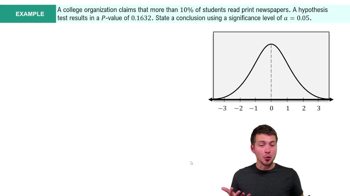
Step 4: State Conclusion Example 4
Pratica correlata
Domanda del libro di testo

Test Statistics

In Exercises 9–12, refer to the exercise identified and find the value of the test statistic. (Refer to Table 8-2 to select the correct expression for evaluating the test statistic.)


Exercise 5 “Landline Phones”

128
views
Domanda del libro di testo

Interpreting P-value The Ericsson method is one of several methods claimed to increase the likelihood of a baby girl. In a clinical trial, results could be analyzed with a formal hypothesis test with the alternative hypothesis of p > 0.5 which corresponds to the claim that the method increases the likelihood of having a girl, so that the proportion of girls is greater than 0.5. If you have an interest in establishing the success of the method, which of the following P-values would you prefer as a result in your hypothesis test: 0.999, 0.5, 0.95, 0.05, 0.01, 0.001? Why?

188
views
Domanda del libro di testo

Testing Claims About Proportions

In Exercises 9–32, test the given claim. Identify the null hypothesis, alternative hypothesis, test statistic, P-value, or critical value(s), then state the conclusion about the null hypothesis, as well as the final conclusion that addresses the original claim. Use the P-value method unless your instructor specifies otherwise. Use the normal distribution as an approximation to the binomial distribution, as described in Part 1 of this section.


Online Friends A Pew Research Center poll of 1060 teens aged 13 to 17 showed that 57% of them have made new friends online. Use a 0.01 significance level to test the claim that half of all teens have made new friends online.

82
views
Domanda del libro di testo

Testing Claims About Variation

In Exercises 5–16, test the given claim. Identify the null hypothesis, alternative hypothesis, test statistic, P-value, or critical value(s), then state the conclusion about the null hypothesis, as well as the final conclusion that addresses the original claim. Assume that a simple random sample is selected from a normally distributed population.


Birth Weights A simple random sample of birth weights of 30 girls has a standard deviation of 829.5 g. Use a 0.01 significance level to test the claim that birth weights of girls have the same standard deviation as birth weights of boys, which is 660.2 g (based on Data Set 6 “Births” in Appendix B).

116
views
Domanda del libro di testo

Exact Method For each of the three different methods of hypothesis testing (identified in the left column), enter the P-values corresponding to the given alternative hypothesis and sample data. Use a 0.05 significance level. Note that the entries in the last column correspond to the Chapter Problem. How do the results agree with the large sample size?

180
views
Domanda del libro di testo

Type I and Type II Errors

In Exercises 25–28, provide statements that identify the type I error and the type II error that correspond to the given claim. (Although conclusions are usually expressed in verbal form, the answers here can be expressed with statements that include symbolic expressions such as p = 0.1.)


The proportion of drivers who make angry gestures is greater than 0.25.

119
views