Skip to main content
Trigonometry
Il mio corso
Impara
Preparazione agli esami
AI Tutor
Guide di studio
Soluzioni per libri di testo
Flashcard
Esplora
Prova l'app
Il mio corso
Impara
Preparazione agli esami
AI Tutor
Guide di studio
Soluzioni per libri di testo
Flashcard
Esplora
Prova l'app
Indietro
Direction of a Vector definitions
Puoi toccare per girare la carta.
Vector
Puoi toccare per girare la carta.
👆
Vector
A quantity with both magnitude and orientation, often represented as an arrow in coordinate space.
Avanzamenti del tracciato
I pulsanti di controllo sono stati cambiati in modalità "navigazione".
1/15
Flashcard correlate
Pratica correlata
Video consigliati
Direction of a Vector quiz
Direction of a Vector
15 Termini
Direction of a Vector
8. Vectors
3 Problemi
Argomento
ErnestBlazevic
Unit Vectors and i & j Notation
8. Vectors
1 problema
Argomento
8. Vectors
5 Argomenti
11 Problemi
Capitolo
Patrick
VideoThumbView.guidedCourse
04:55
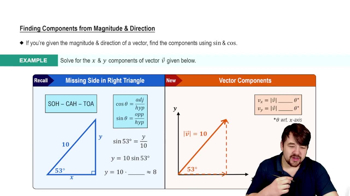
Finding Components from Direction and Magnitude
587
views
2
rank
VideoThumbView.guidedCourse
05:13
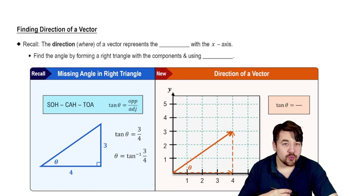
Finding Direction of a Vector
785
views
4
rank
VideoThumbView.guidedCourse
04:19
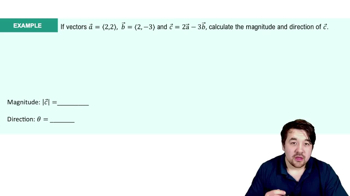
Finding Direction of a Vector Example 1
679
views
2
rank
Termini in questo insieme (15)
Nascondere definizioni
Vector
A quantity with both magnitude and orientation, often represented as an arrow in coordinate space.
Direction
The angle measured from the positive x-axis to a vector, indicating its orientation in space.
Magnitude
The length or size of a vector, calculated using its components and representing its strength.
X-axis
The horizontal reference line in a coordinate system, used to measure angles and vector components.
Y-axis
The vertical reference line in a coordinate system, used to measure angles and vector components.
Component
A part of a vector along a specific axis, found using trigonometric functions and the vector's direction.
Tangent Function
A trigonometric ratio comparing the y-component to the x-component, used to determine vector angles.
Inverse Tangent
A function that finds the angle whose tangent is a given value, essential for calculating vector direction.
Cosine Function
A trigonometric ratio used to find the x-component of a vector from its magnitude and direction.
Sine Function
A trigonometric ratio used to find the y-component of a vector from its magnitude and direction.
Quadrant
One of four regions in the coordinate plane, affecting how vector direction is expressed and calculated.
Unit Circle
A circle with radius one, used to relate angles in radians to trigonometric values for vector calculations.
Radians
A unit for measuring angles, often used in trigonometric calculations for vector direction and components.
SOHCAHTOA
A mnemonic for remembering trigonometric ratios, crucial for solving vector component and direction problems.
Hypotenuse
The longest side of a right triangle, corresponding to the magnitude of a vector in component calculations.
 IndietroIndietro

 04:55
04:55