Skip to main content
Trigonometry
Il mio corso
Impara
Preparazione agli esami
AI Tutor
Guide di studio
Soluzioni per libri di testo
Flashcard
Esplora
Prova l'app
Il mio corso
Impara
Preparazione agli esami
AI Tutor
Guide di studio
Soluzioni per libri di testo
Flashcard
Esplora
Prova l'app
Indietro
Direction of a Vector quiz
Puoi toccare per girare la carta.
What is the direction of a vector defined as?
Puoi toccare per girare la carta.
👆
What is the direction of a vector defined as?
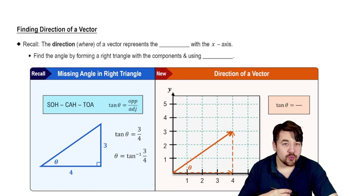
The direction of a vector is the angle it makes with the x-axis.
Avanzamenti del tracciato
I pulsanti di controllo sono stati cambiati in modalità "navigazione".
1/15
Flashcard correlate
Pratica correlata
Video consigliati
Direction of a Vector definitions
Direction of a Vector
15 Termini
Direction of a Vector
8. Vectors
3 Problemi
Argomento
ErnestBlazevic
Unit Vectors and i & j Notation
8. Vectors
1 problema
Argomento
8. Vectors
5 Argomenti
11 Problemi
Capitolo
Patrick
VideoThumbView.guidedCourse
04:55
Finding Components from Direction and Magnitude
588
views
2
rank
VideoThumbView.guidedCourse
05:13
Finding Direction of a Vector
786
views
4
rank
VideoThumbView.guidedCourse
04:19
Finding Direction of a Vector Example 1
681
views
2
rank
Termini in questo insieme (15)
Nascondere definizioni
What is the direction of a vector defined as?
The direction of a vector is the angle it makes with the x-axis.
Which trigonometric function is used to calculate the direction angle of a vector from its components?
The tangent function (tan) is used, specifically tan(theta) = y-component / x-component.
How do you find the direction angle (theta) of a vector given its x and y components?
You use the inverse tangent: theta = arctan(y-component / x-component).
If the calculated direction angle is negative, how do you express it as a positive angle from the x-axis?
Subtract the negative angle from 360 degrees to get the positive direction angle.
What is the direction of the vector (2, -1) expressed as a positive angle from the x-axis?
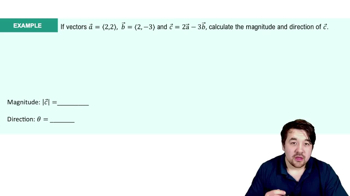
It is 333 degrees, found by calculating arctan(-1/2) ≈ -27 degrees and then 360 - 27 = 333 degrees.
How do you find the direction of a vector in the third quadrant, such as (-3, -3)?
Calculate arctan(y/x) to get the reference angle, then add 180 degrees to account for the third quadrant.
What is the direction of the vector (-3, -3) from the positive x-axis?
It is 225 degrees, found by adding 180 degrees to the reference angle of 45 degrees.
How do you find the x-component of a vector given its magnitude and direction angle?
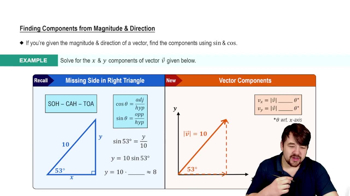
Multiply the magnitude by the cosine of the direction angle: x = magnitude × cos(angle).
How do you find the y-component of a vector given its magnitude and direction angle?
Multiply the magnitude by the sine of the direction angle: y = magnitude × sin(angle).
If a vector has a magnitude of 10 and a direction of 53 degrees, what are its x and y components?
The x-component is 6 (10 × cos(53°)), and the y-component is 8 (10 × sin(53°)).
How do you calculate the x-component of a vector with magnitude 5 and direction 2π/3 radians?
Multiply 5 by the cosine of 2π/3, which gives -5/2.
How do you calculate the y-component of a vector with magnitude 5 and direction 2π/3 radians?
Multiply 5 by the sine of 2π/3, which gives (5√3)/2.
What does a negative x-component and a positive y-component indicate about a vector's location?
It means the vector is in the second quadrant.
What memory tool helps recall the relationships between sides and angles in right triangles for vectors?
SOHCAHTOA helps remember the sine, cosine, and tangent relationships.
Why is it important to use trigonometric functions when finding vector components?
Trigonometric functions allow you to break a vector into its x and y components, which is essential for solving problems in math and science.
 IndietroIndietro

 04:55
04:55