 Indietro
Angles, Right Triangles, and Trigonometric Function Values: Study Notes
Guida di studio - Note intelligenti
 Appunti personalizzati basati sui tuoi materiali, ampliati con definizioni chiave, esempi e contesto.
Chapter 2: Angles, Right Triangles, and Trigonometric Function Values
Solving Right Triangles
Solving a right triangle involves finding all unknown sides and angles using trigonometric ratios and the Pythagorean Theorem. This process is fundamental in trigonometry and is widely used in applications involving measurements and indirect calculations.
Given: At least one side and one non-right angle, or two sides.
Goal: Find all missing sides and angles.
Key Ratios: Sine, cosine, and tangent relate angles to side lengths.
Pythagorean Theorem: (where c is the hypotenuse)
Example: Given a right triangle with legs 8 and 15, find the hypotenuse and the other angles.
Find hypotenuse:
Find angles using trigonometric ratios:
,
,
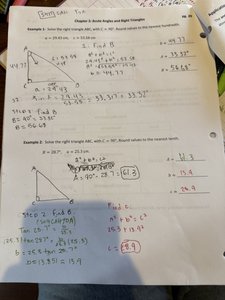
Rounding in Trigonometric Calculations
When solving triangles, answers are often rounded to a specified decimal place. The level of rounding depends on the context or instructions provided.
Exact | Rounded to nearest integer | Rounded to nearest tenth | Rounded to nearest hundredth |
|---|---|---|---|
16.12345 | 16 | 16.1 | 16.12 |
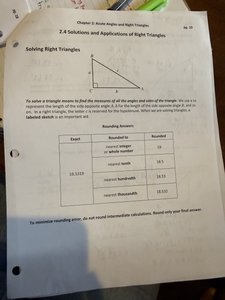
2.3 Approximations of Trigonometric Function Values
Calculator Use and Degree/Radian Mode
Calculators are used to approximate trigonometric function values. It is essential to set the calculator to the correct mode (degree or radian) based on the angle's unit.
Degree Mode: Used when angles are given in degrees.
Radian Mode: Used when angles are given in radians.
Example: ,
Calculator Steps:
Enter the angle value.
Select the trigonometric function (sin, cos, tan).
Ensure the calculator is in the correct mode.
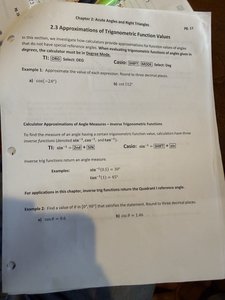
Inverse Trigonometric Functions
Inverse trigonometric functions are used to find angle measures when given a trigonometric ratio. These are essential for solving triangles when an angle is unknown.
Inverse Sine: or
Inverse Cosine: or
Inverse Tangent: or
Example: If , then .
Applications of Right Triangles
Angles of Elevation and Depression
The angle of elevation is the angle formed by a horizontal line and the line of sight to an object above the horizontal. The angle of depression is the angle formed by a horizontal line and the line of sight to an object below the horizontal.
Used in real-world problems involving heights and distances.
Trigonometric ratios relate the angle to the object's height and distance.
Example: If the angle of elevation to the top of a building is and the observer is 50 ft from the building, the height can be found using: 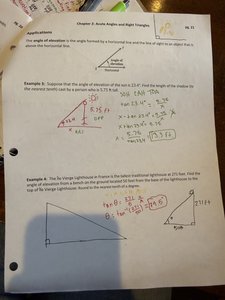
Solving Application Problems
Application problems often involve drawing a diagram, labeling known and unknown values, and applying trigonometric ratios to solve for the unknowns.
Identify the right triangle in the scenario.
Assign variables to unknown sides or angles.
Use sine, cosine, or tangent as appropriate.
Example: A lighthouse is 275 ft tall. The angle of elevation from a boat to the top of the lighthouse is . The distance from the boat to the base is:
Practice Problems and Solutions
Solving for Sides and Angles
Practice problems reinforce the process of solving right triangles and applying trigonometric ratios to find unknown values.
Given two sides, use the Pythagorean Theorem to find the third.
Given a side and an angle, use sine, cosine, or tangent to find other sides or angles.
Example: In triangle ABC, , , . Find and the other angles.
,
Finding Angles Given Trigonometric Values
To find an angle given a trigonometric value, use the inverse function and ensure the answer is within the specified interval (usually ).
Example: Find such that in .
and (since cosine is positive in quadrants I and IV).
Summary Table: Trigonometric Ratios for Right Triangles
Function | Ratio | Inverse Function |
|---|---|---|
Sine | ||
Cosine | ||
Tangent |
Additional info: These notes synthesize and expand upon the provided handwritten and printed materials, ensuring all key concepts and examples are clearly explained for college-level trigonometry students.
