 Indietro
Comprehensive Study Notes for College Trigonometry: Angles, Triangles, and Radian Measure
Guida di studio - Note intelligenti
 Appunti personalizzati basati sui tuoi materiali, ampliati con definizioni chiave, esempi e contesto.
Review of College Algebra
Basic Terminology and Geometric Foundations
Trigonometry builds on foundational concepts from algebra and geometry, including points, lines, segments, rays, and angles. Understanding these basics is essential for the study of trigonometric functions and their applications.
Line: Determined by two distinct points and extends infinitely in both directions.
Line Segment: The portion of a line between two points, including the endpoints.
Ray: Starts at one point and extends infinitely in one direction.
Angle: Formed by two rays with a common endpoint (vertex). The initial side is the starting position, and the terminal side is the position after rotation.
Angle Measurement: Angles are measured in degrees (°) or radians. A full rotation is 360°, and 1° = 60' (minutes), 1' = 60" (seconds).
Acute Angle: 0° < θ < 90°
Right Angle: θ = 90°
Obtuse Angle: 90° < θ < 180°
Straight Angle: θ = 180°
Complementary Angles: Two angles whose measures sum to 90°. Supplementary Angles: Two angles whose measures sum to 180°.
Measuring Angles
Degrees, Minutes, and Seconds (DMS) and Decimal Degrees
Angles can be expressed in degrees, minutes, and seconds (DMS) or as decimal degrees. Conversion between these forms is often required in trigonometric calculations.
To convert DMS to decimal degrees: Add degrees + (minutes/60) + (seconds/3600).
To convert decimal degrees to DMS: The integer part is degrees; multiply the decimal part by 60 for minutes, and repeat for seconds.
Example: Convert 126°34'46" to decimal degrees:
Example: Convert -27.455° to DMS: Degrees = 27°, 0.455 × 60 = 27.3', 0.3 × 60 = 18" → -27°27'18"
Standard Position and Coterminal Angles
An angle is in standard position if its vertex is at the origin and its initial side lies along the positive x-axis. Coterminal angles share the same initial and terminal sides but may differ by multiples of 360°.
General form for coterminal angles: , where n is any integer.
Example: All angles coterminal with 30°:
Trigonometric Functions on Right Triangles
Definitions and Mnemonics
Trigonometric functions relate the angles of a right triangle to the ratios of its sides. The primary functions are sine, cosine, and tangent, with their reciprocals cosecant, secant, and cotangent.
Sine (sin):
Cosine (cos):
Tangent (tan):
Cosecant (csc):
Secant (sec):
Cotangent (cot):
Mnemonic: SOH-CAH-TOA helps remember the definitions.
Special Right Triangles
45°-45°-90° triangle: Sides are in the ratio 1:1:
30°-60°-90° triangle: Sides are in the ratio 1::2
Example: In a 30°-60°-90° triangle, , ,
Unit Circle
Definition and Circular Functions
The unit circle is a circle of radius 1 centered at the origin. It is fundamental in defining trigonometric functions for all real numbers, not just angles in triangles. The coordinates of a point on the unit circle corresponding to an angle are .
Equation of the unit circle:
For any real number (arc length): , , (if )
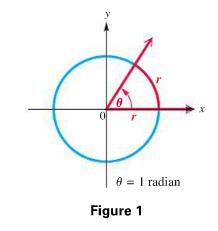
Reference Angles: The reference angle is the smallest positive angle between the terminal side of and the x-axis. It is used to find trigonometric values for any angle.
Radian Measure
Definition and Conversion
A radian is the angle at the center of a circle that intercepts an arc equal in length to the radius. Radian measure is essential for calculus and advanced trigonometry.
Conversion: radians
Degrees to radians:
Radians to degrees:
Example: Convert to radians:
Applications of Radian Measure
Arc Length and Area of a Sector
Arc Length: , where is in radians
Area of a Sector: , where is in radians
Example: For a circle of radius 3 and central angle , arc length
Linear and Angular Speed
Linear speed:
Angular speed: (in radians per unit time)
Relationship:
Trigonometric Functions of Non-Acute Angles
Reference Angles and Signs in Quadrants
For angles outside the range [0°, 90°], reference angles and quadrant signs are used to determine trigonometric values.
Quadrant I: All functions positive
Quadrant II: Sine and cosecant positive
Quadrant III: Tangent and cotangent positive
Quadrant IV: Cosine and secant positive
Mnemonic: "All Students Take Calculus" (ASTC)
Trigonometric Identities
Pythagorean and Reciprocal Identities
Pythagorean Identity:
Other forms: ,
Reciprocal Identities: , ,
Applications: Bearings, Elevation, and Refraction
Bearings and Navigation
Bearings are used in navigation to describe direction. A bearing is measured clockwise from north. Quadrant bearings use N/S as a reference and an acute angle toward E/W.
Example: S 30° E means 30° east of due south.
Angles of Elevation and Depression
The angle of elevation is measured upward from the horizontal; the angle of depression is measured downward. These are used in applications involving heights and distances.
Snell's Law and Refraction
When light passes from one medium to another, its speed and direction change according to Snell's Law:
, where and are the speeds of light in the two media, and , are the angles of incidence and refraction.
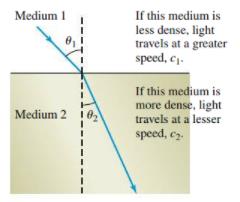
If the second medium is denser, light slows down and bends toward the normal.
Summary Table: Domains of Trigonometric Functions
Function | Domain (in radians) |
|---|---|
Sine, Cosine | All real numbers |
Tangent, Secant | , n integer |
Cotangent, Cosecant | , n integer |
Quick Reference: Special Angles and Values
Angle | sin | cos | tan |
|---|---|---|---|
30° () | |||
45° () | 1 | ||
60° () |
Additional info: This guide covers all foundational topics from angles and triangles to radian measure, the unit circle, and applications, as required for a college-level trigonometry course. It includes key definitions, formulas, and examples, as well as relevant images and tables for clarity.
