 Indietro
Measuring Angles: Standard Position, Types, Complementary & Supplementary Angles, and Radian Conversion
Guida di studio - Note intelligenti
 Appunti personalizzati basati sui tuoi materiali, ampliati con definizioni chiave, esempi e contesto.
Measuring Angles
Angles in Standard Position
Angles are fundamental in trigonometry and are measured in degrees (°) or radians. An angle in standard position has its vertex at the origin of the coordinate plane, with its initial side along the positive x-axis. The amount of rotation from the initial side to the terminal side determines the angle's measure.
Initial Side: The starting position of the angle (along the positive x-axis).
Terminal Side: The position after rotation.
Positive Angles: Measured counterclockwise from the initial side.
Negative Angles: Measured clockwise from the initial side.
Types of Angles:
Acute Angle:
Right Angle:
Obtuse Angle:
Straight Angle:
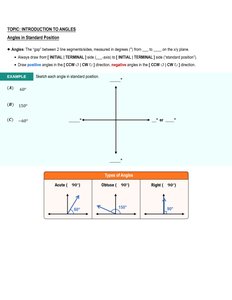
Example: Sketching angles such as , , and in standard position involves rotating from the positive x-axis by the specified amount, using the appropriate direction (counterclockwise for positive, clockwise for negative).
Complementary & Supplementary Angles
Introduction to Complementary & Supplementary Angles
Complementary and supplementary angles are pairs of angles with specific sum properties:
Complementary Angles: Two angles whose measures add up to .
Supplementary Angles: Two angles whose measures add up to .
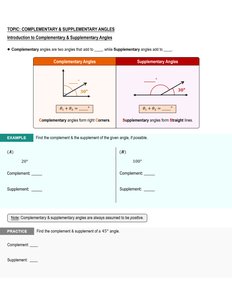
Example: The complement of is because . The supplement of $20^\circ$ is because .
Note: Complementary and supplementary angles are always considered positive in standard trigonometric problems.
Solving Problems with Complementary & Supplementary Angles
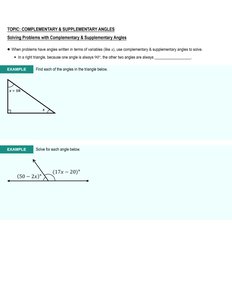
When solving for unknown angles, use the definitions above. In right triangles, the two non-right angles are always complementary. For algebraic expressions, set up equations based on the sum properties.
Example: If one angle is , its complement is and its supplement is .
Example: If and are supplementary, then .
Radian Measure and Converting Between Degrees & Radians
Converting Between Degrees & Radians
Radians are another unit for measuring angles, based on the arc length of a circle. One full revolution (circle) is or radians. The conversion formulas are:
From degrees to radians:
From radians to degrees:
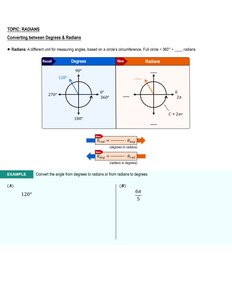
Example: To convert to radians: radians. To convert radians to degrees: .
