 Indietro
Step-by-Step Guidance for Trigonometry Worksheet (Angles, Terminal Sides, Supplementary Angles)
Guida di studio - Note intelligenti
 Appunti personalizzati basati sui tuoi materiali, ampliati con definizioni chiave, esempi e contesto.
Q1. Find the following:
a. The supplement of the angle 30°
b. The complement of the angle 20°
c. Find the least positive coterminal angle for the following: 420° and -45°
Background
Topic: Angle Relationships and Coterminal Angles
This question tests your understanding of supplementary and complementary angles, as well as how to find coterminal angles by adding or subtracting multiples of 360°.
Key Terms and Formulas:
Supplementary angles: Two angles whose sum is 180°.
Complementary angles: Two angles whose sum is 90°.
Coterminal angles: Angles that share the same terminal side; found by adding or subtracting 360°.
Step-by-Step Guidance
For part (a), recall that the supplement of an angle is .
For part (b), recall that the complement of an angle is .
For part (c), to find the least positive coterminal angle for 420°, subtract 360° until the result is between 0° and 360°.
For -45°, add 360° until the result is between 0° and 360°.
Try solving on your own before revealing the answer!
Final Answer:
a.
b.
c. Least positive coterminal angle for 420°: Least positive coterminal angle for -45°:
Supplement and complement are found by subtracting from 180° and 90°, respectively. Coterminal angles are found by adding or subtracting 360° until the angle is positive and less than 360°.
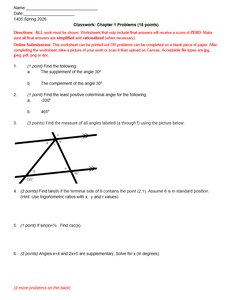
Q2. Find the measure of all angles labeled 1 through 5 using the picture below.
Background
Topic: Angle Relationships (Vertical, Adjacent, Linear Pair)
This question tests your ability to use geometric relationships between angles formed by intersecting lines, such as vertical angles and linear pairs.
Key Terms and Formulas:
Vertical angles: Opposite angles formed by intersecting lines; they are equal.
Linear pair: Adjacent angles whose sum is 180°.
Sum of angles around a point: 360°.
Step-by-Step Guidance
Identify which angles are vertical pairs and which are linear pairs in the diagram.
Use the property that vertical angles are equal to set up equations for the unknowns.
Use the property that linear pairs sum to 180° to relate adjacent angles.
Write equations based on the relationships and solve for the unknowns, stopping before the final calculation.
Try solving on your own before revealing the answer!
Final Answer:
Angles 1 and 3 are vertical angles and are equal.
Angles 2 and 4 are vertical angles and are equal.
Angle 5 forms a linear pair with angle 1 (sum is 180°).
Specific values depend on the diagram, but typically: If angle 1 = x, then angle 3 = x, angle 5 = 180° - x, etc.
By using vertical and linear pair relationships, you can solve for all angles in the diagram.
Q3. Find tan(θ) if the terminal side of θ contains the point (2,1). Assume θ is in standard position. (Hint: Use trigonometric ratios with x, y, and r values.)
Background
Topic: Trigonometric Ratios (Tangent)
This question tests your ability to use the definition of tangent in terms of coordinates on the terminal side of an angle in standard position.
Key Terms and Formulas:
Standard position: Angle with its vertex at the origin and initial side along the positive x-axis.
Tangent ratio:
Point (x, y): Coordinates on the terminal side.
Step-by-Step Guidance
Identify the coordinates: , .
Recall the tangent ratio: .
Set up the expression for tangent using the given values.
Stop before calculating the final value.
Try solving on your own before revealing the answer!
Final Answer:
We use the definition of tangent as the ratio of y to x for a point on the terminal side.
Q4. Find sin(45°).
Background
Topic: Trigonometric Values of Special Angles
This question tests your knowledge of the sine value for a commonly used angle (45°).
Key Terms and Formulas:
Sine function:
Special angle values:
Step-by-Step Guidance
Recall the exact value for from the unit circle or special triangles.
Set up the expression for .
Stop before stating the final value.
Try solving on your own before revealing the answer!
Final Answer:
This is a standard value from the unit circle or 45-45-90 triangle.
Q5. Angles x and 2x are supplementary. Solve for x (in degrees).
Background
Topic: Supplementary Angles and Algebraic Equations
This question tests your ability to set up and solve an equation based on the definition of supplementary angles.
Key Terms and Formulas:
Supplementary angles:
Step-by-Step Guidance
Write the equation for supplementary angles: .
Combine like terms to get .
Set up the equation to solve for by dividing both sides by 3.
Stop before calculating the final value.
Try solving on your own before revealing the answer!
Final Answer:
Since , dividing both sides by 3 gives .
