Ch. 1 - Angles and the Trigonometric Functions
Blitzer - Trigonometry 3rd Edition
Blitzer3rd EditionTrigonometryISBN: 9780137316601Non è quello che usi tu?Cambia libro di testo
Capitolo 1, Problema 4

In Exercises 2–4, convert each angle in degrees to radians. Express your answer as a multiple of 𝜋. 315°

Guida verificata passo dopo passo
1
Recall the formula to convert degrees to radians: \(\text{radians} = \text{degrees} \times \frac{\pi}{180}\).
Substitute the given angle 315° into the formula: \(315 \times \frac{\pi}{180}\).
Simplify the fraction \(\frac{315}{180}\) by finding the greatest common divisor (GCD) of 315 and 180.
Divide both numerator and denominator by the GCD to reduce the fraction to its simplest form.
Express the final answer as a multiple of \(\pi\) using the simplified fraction.

Risposta video verificata per un problema simile:

Questa soluzione video è stata consigliata dai nostri tutor come utile per risolvere questo problema.
Durata del video:
2m

Concetti chiave

Ecco i concetti essenziali che devi comprendere per rispondere correttamente alla domanda.

Degree to Radian Conversion

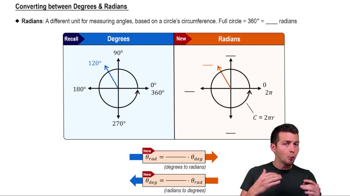
Degrees and radians are two units for measuring angles. To convert degrees to radians, multiply the degree measure by π/180. This conversion is essential because radians are the standard unit in many trigonometric applications.
Video consigliato:
Percorso guidato
5:04
Converting between Degrees & Radians

Understanding π as a Constant

π (pi) is an irrational constant approximately equal to 3.14159, representing the ratio of a circle's circumference to its diameter. Expressing angles as multiples of π provides a precise and standardized way to represent radian measures.
Video consigliato:
Percorso guidato
6:02
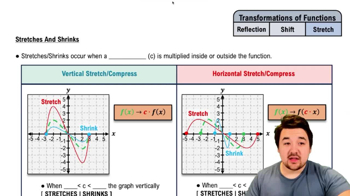
Stretches and Shrinks of Functions

Simplifying Radicals and Fractions

After converting degrees to radians, the resulting fraction should be simplified to its lowest terms. This involves reducing the numerator and denominator by their greatest common divisor to express the angle neatly as a multiple of π.
Video consigliato:
Percorso guidato
4:02
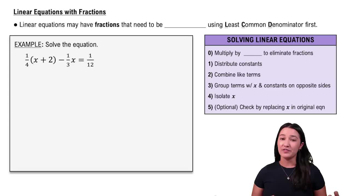
Solving Linear Equations with Fractions