Ch. 1 - Angles and the Trigonometric Functions
Blitzer - Trigonometry 3rd Edition
Blitzer3rd EditionTrigonometryISBN: 9780137316601Non è quello che usi tu?Cambia libro di testo
Capitolo 1, Problema 28

In Exercises 28–29, find a cofunction with the same value as the given expression. sin 70°

Guida verificata passo dopo passo
1
Recall the cofunction identity for sine and cosine: \(\sin(\theta) = \cos(90^\circ - \theta)\).
Identify the angle in the given expression: here, \(\theta = 70^\circ\).
Apply the cofunction identity by substituting \(\theta\) with \(70^\circ\): \(\sin 70^\circ = \cos(90^\circ - 70^\circ)\).
Simplify the expression inside the cosine: \(90^\circ - 70^\circ = 20^\circ\).
Write the final cofunction expression: \(\sin 70^\circ = \cos 20^\circ\).

Risposta video verificata per un problema simile:

Questa soluzione video è stata consigliata dai nostri tutor come utile per risolvere questo problema.
Durata del video:
1m

Concetti chiave

Ecco i concetti essenziali che devi comprendere per rispondere correttamente alla domanda.

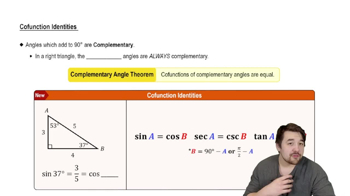
Cofunction Identity

Cofunction identities relate trigonometric functions of complementary angles, meaning angles that add up to 90°. For sine and cosine, sin(θ) = cos(90° - θ). This identity allows us to find a cofunction with the same value by subtracting the given angle from 90°.
Video consigliato:
Percorso guidato
6:30
Cofunction Identities

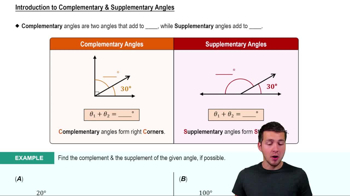
Complementary Angles

Complementary angles are two angles whose measures add up to 90°. Understanding this concept is essential because cofunction identities depend on the relationship between complementary angles, enabling the conversion between sine and cosine values.
Video consigliato:
Percorso guidato
3:35
Intro to Complementary & Supplementary Angles

Evaluating Trigonometric Functions at Specific Angles

Evaluating trigonometric functions at specific angles, such as 70°, involves understanding angle measures and their corresponding function values. This skill helps in applying cofunction identities correctly to find equivalent expressions.
Video consigliato:
Percorso guidato
3:48
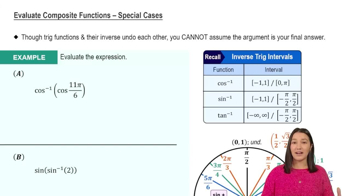
Evaluate Composite Functions - Special Cases