Ch. 1 - Angles and the Trigonometric Functions
Blitzer - Trigonometry 3rd Edition
Blitzer3rd EditionTrigonometryISBN: 9780137316601Non è quello che usi tu?Cambia libro di testo
Capitolo 1, Problema 1.1.51

In Exercises 41–56, use the circle shown in the rectangular coordinate system to draw each angle in standard position. State the quadrant in which the angle lies. When an angle's measure is given in radians, work the exercise without converting to degrees.
Circle in rectangular coordinates for measuring angles in standard position.
120°

Guida verificata passo dopo passo
1
Understand that the angle is measured in standard position, meaning its vertex is at the origin and the initial side lies along the positive x-axis.
Since the angle is 120°, start from the positive x-axis and rotate counterclockwise by 120°.
Locate 120° on the circle: it is between 90° and 180°, which places the terminal side of the angle in the second quadrant.
Draw the terminal side of the angle so that it forms a 120° rotation from the positive x-axis, intersecting the circle in the second quadrant.
State that the angle lies in the second quadrant because 120° is greater than 90° but less than 180°.

Risposta video verificata per un problema simile:

Questa soluzione video è stata consigliata dai nostri tutor come utile per risolvere questo problema.
Durata del video:
1m

Concetti chiave

Ecco i concetti essenziali che devi comprendere per rispondere correttamente alla domanda.

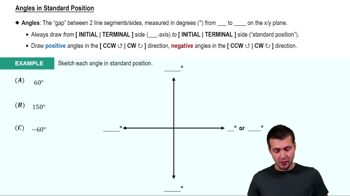
Angles in Standard Position

An angle is in standard position when its vertex is at the origin of the coordinate system and its initial side lies along the positive x-axis. The terminal side is determined by rotating the initial side counterclockwise for positive angles and clockwise for negative angles.
Video consigliato:
Percorso guidato
05:50
Drawing Angles in Standard Position

Quadrants of the Coordinate Plane

The coordinate plane is divided into four quadrants by the x- and y-axes. Quadrant I has positive x and y values, Quadrant II has negative x and positive y, Quadrant III has negative x and y, and Quadrant IV has positive x and negative y. The quadrant of an angle depends on the location of its terminal side.
Video consigliato:
Percorso guidato
6:36
Quadratic Formula

Measuring Angles in Degrees and Radians

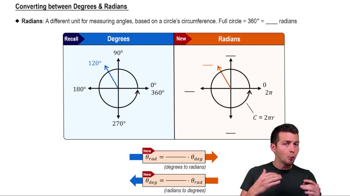
Angles can be measured in degrees or radians. Degrees divide a circle into 360 parts, while radians relate the angle to the radius of the circle. For this problem, angles are given in degrees (e.g., 120°), and the task is to identify the quadrant without converting to radians.
Video consigliato:
Percorso guidato
5:04
Converting between Degrees & Radians