Ch. 1 - Angles and the Trigonometric Functions
Blitzer - Trigonometry 3rd Edition
Blitzer3rd EditionTrigonometryISBN: 9780137316601Non è quello che usi tu?Cambia libro di testo
Capitolo 1, Problema 81

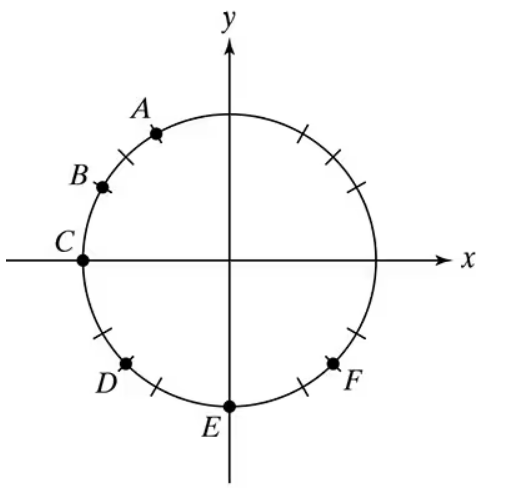
Use the circle shown in the rectangular coordinate system to solve Exercises 81–86. Find two angles, in radians, between -2𝜋 and 2𝜋 such that each angle's terminal side passes through the origin and the given point.

A

Guida verificata passo dopo passo
1
Identify the coordinates of the given point on the circle. From the image, the point is located in the first quadrant, slightly above the positive x-axis.
Determine the reference angle formed by the terminal side of the angle and the positive x-axis. This angle corresponds to the position of the point on the unit circle.
Express the first angle in radians as the reference angle itself, since it lies between 0 and 2𝜋.
Find the second angle by considering the angle with the same terminal side but measured in the negative (clockwise) direction. This angle will be negative and between -2𝜋 and 0.
Write both angles in radians, ensuring they are between -2𝜋 and 2𝜋, and verify that their terminal sides pass through the given point on the circle.

Risposta video verificata per un problema simile:

Questa soluzione video è stata consigliata dai nostri tutor come utile per risolvere questo problema.
Durata del video:
8m

Concetti chiave

Ecco i concetti essenziali che devi comprendere per rispondere correttamente alla domanda.

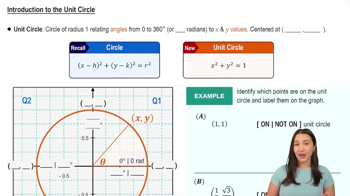
Unit Circle and Coordinates

The unit circle is a circle with radius 1 centered at the origin in the coordinate plane. Points on the unit circle correspond to angles measured from the positive x-axis, and their coordinates (x, y) represent the cosine and sine of those angles, respectively.
Video consigliato:
Percorso guidato
06:11
Introduction to the Unit Circle

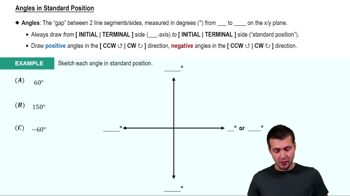
Angles in Standard Position and Radians

An angle in standard position has its vertex at the origin and its initial side along the positive x-axis. Angles are measured in radians, where 2π radians correspond to a full circle. Angles can be positive (counterclockwise) or negative (clockwise), and multiple angles can share the same terminal side.
Video consigliato:
Percorso guidato
05:50
Drawing Angles in Standard Position

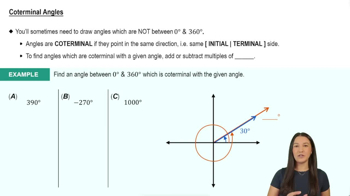
Finding Coterminal Angles

Coterminal angles share the same terminal side but differ by full rotations of 2π radians. To find two angles between -2π and 2π with the same terminal side, add or subtract multiples of 2π from a given angle, ensuring the angles fall within the specified range.
Video consigliato:
Percorso guidato
04:46
Coterminal Angles