Ch. 1 - Angles and the Trigonometric Functions
Blitzer - Trigonometry 3rd Edition
Blitzer3rd EditionTrigonometryISBN: 9780137316601Non è quello che usi tu?Cambia libro di testo
Capitolo 1, Problema 84

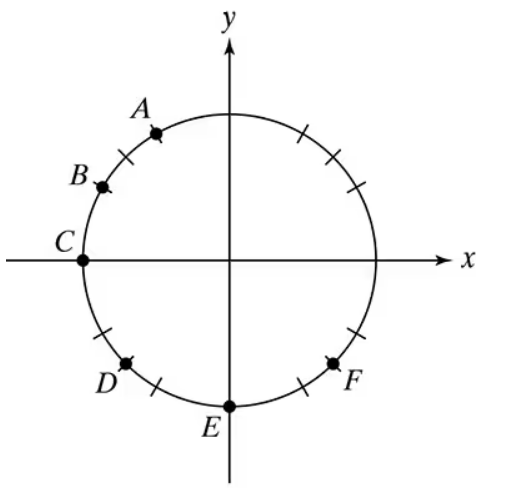
Use the circle shown in the rectangular coordinate system to solve Exercises 81–86. Find two angles, in radians, between -2𝜋 and 2𝜋 such that each angle's terminal side passes through the origin and the given point.
Unit circle centered at the origin on an xy-coordinate plane with labeled points A, B, C, D, E, and F.
F

Guida verificata passo dopo passo
1
Identify the coordinates of point Z on the unit circle. From the image, point Z is located in the fourth quadrant, near the positive x-axis and negative y-axis.
Determine the reference angle \( \theta_r \) that point Z makes with the positive x-axis. Since the circle is divided into 12 equal parts, each part corresponds to an angle of \( \frac{2\pi}{12} = \frac{\pi}{6} \). Point Z is located at the 11th tick mark, so the reference angle is \( \theta_r = \frac{\pi}{6} \).
Find the first angle \( \theta_1 \) in radians between \( -2\pi \) and \( 2\pi \) whose terminal side passes through point Z. Since Z is in the fourth quadrant, \( \theta_1 = 2\pi - \theta_r = 2\pi - \frac{\pi}{6} \).
Find the second angle \( \theta_2 \) in radians between \( -2\pi \) and \( 2\pi \) whose terminal side passes through point Z. This angle is the negative coterminal angle of \( \theta_1 \), so \( \theta_2 = \theta_1 - 2\pi = (2\pi - \frac{\pi}{6}) - 2\pi = -\frac{\pi}{6} \).
Verify that both angles \( \theta_1 \) and \( \theta_2 \) lie within the interval \( -2\pi \) to \( 2\pi \) and that their terminal sides pass through point Z on the unit circle.

Risposta video verificata per un problema simile:

Questa soluzione video è stata consigliata dai nostri tutor come utile per risolvere questo problema.
Durata del video:
8m

Concetti chiave

Ecco i concetti essenziali che devi comprendere per rispondere correttamente alla domanda.

Unit Circle and Angle Measurement

The unit circle is a circle with radius 1 centered at the origin of the coordinate system. Angles in radians are measured from the positive x-axis, with positive angles rotating counterclockwise and negative angles clockwise. Understanding the unit circle helps relate points on the circle to their corresponding angle measures.
Video consigliato:
Percorso guidato
06:11
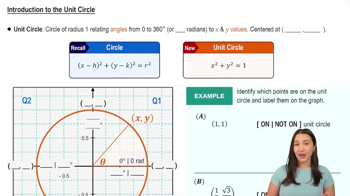
Introduction to the Unit Circle

Terminal Side of an Angle

The terminal side of an angle is the ray that starts at the origin and passes through a point on the circle. Identifying the terminal side helps determine the angle's measure. Since angles can be coterminal, multiple angles can share the same terminal side but differ by multiples of 2π.
Video consigliato:
Percorso guidato
04:46
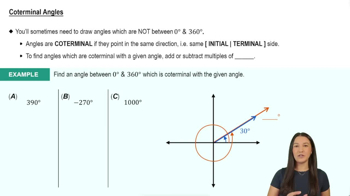
Coterminal Angles

Finding Angles Between -2π and 2π

To find angles between -2π and 2π with a given terminal side, consider both positive and negative rotations. For a point on the circle, one angle is the principal angle (0 to 2π), and the other is its negative coterminal angle (between -2π and 0). This ensures all possible angles within the specified range are found.
Video consigliato:
Percorso guidato
04:33
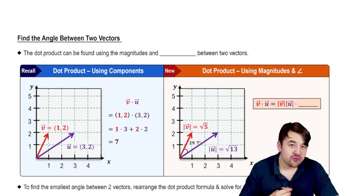
Find the Angle Between Vectors