Ch. 2 - Graphs of the Trigonometric Functions; Inverse Trigonometric Functions
Blitzer - Trigonometry 3rd Edition
Blitzer3rd EditionTrigonometryISBN: 9780137316601Non è quello che usi tu?Cambia libro di testo
Capitolo 2, Problema 21

In Exercises 1–26, find the exact value of each expression. _ cot⁻¹ (−√3)

Guida verificata passo dopo passo
1
Recall that \( \cot^{-1}(x) \) represents the angle \( \theta \) whose cotangent is \( x \), i.e., \( \cot \theta = x \).
Set \( \theta = \cot^{-1}(-\sqrt{3}) \), so \( \cot \theta = -\sqrt{3} \).
Remember that \( \cot \theta = \frac{\cos \theta}{\sin \theta} \), so we are looking for an angle \( \theta \) where the ratio of cosine to sine is \( -\sqrt{3} \).
Identify the reference angle where \( \cot \theta = \sqrt{3} \), which corresponds to \( \theta = \frac{\pi}{6} \) (or 30 degrees), then determine the quadrant where cotangent is negative to find the correct angle for \( -\sqrt{3} \).
Express the final answer as \( \theta = \cot^{-1}(-\sqrt{3}) \) in terms of \( \pi \) using the principal value range of \( \cot^{-1} \), which is typically \( (0, \pi) \).

Risposta video verificata per un problema simile:

Questa soluzione video è stata consigliata dai nostri tutor come utile per risolvere questo problema.
Durata del video:
7m

Concetti chiave

Ecco i concetti essenziali che devi comprendere per rispondere correttamente alla domanda.

Inverse Cotangent Function (cot⁻¹)

The inverse cotangent function, cot⁻¹(x), returns the angle whose cotangent is x. It is the inverse of the cotangent function, which relates an angle to the ratio of the adjacent side over the opposite side in a right triangle. Understanding its range and output values is essential for finding exact angle measures.
Video consigliato:
Percorso guidato
5:37
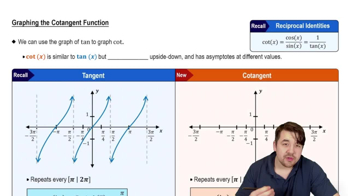
Introduction to Cotangent Graph

Cotangent and Its Relationship to Tangent

Cotangent is the reciprocal of tangent, defined as cot(θ) = 1/tan(θ) = adjacent/opposite. Recognizing this relationship helps convert cotangent values into tangent or sine and cosine values, facilitating the identification of angles corresponding to given cotangent values.
Video consigliato:
Percorso guidato
5:37
Introduction to Cotangent Graph

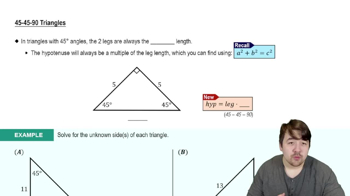
Exact Values of Special Angles

Certain angles, such as 30°, 45°, and 60° (or π/6, π/4, π/3 radians), have well-known exact trigonometric values involving √2 and √3. Knowing these exact values allows for precise evaluation of inverse trigonometric expressions without approximations.
Video consigliato:
Percorso guidato
04:39
45-45-90 Triangles