In Exercises 21–28, an object moves in simple harmonic motion described by the given equation, where t is measured in seconds and d in inches. In each exercise, find the following: a. the maximum displacement b. the frequency c. the time required for one cycle. d = 10 cos 2πt
Ch. 2 - Graphs of the Trigonometric Functions; Inverse Trigonometric Functions

Tutti i libri di testo
Blitzer 3rd Edition
Ch. 2 - Graphs of the Trigonometric Functions; Inverse Trigonometric Functions
Problema 21
Blitzer 3rd Edition
Ch. 2 - Graphs of the Trigonometric Functions; Inverse Trigonometric Functions
Problema 21Capitolo 2, Problema 21
In Exercises 18–24, graph two full periods of the given tangent or cotangent function. y = −tan(x − π/4)
Guida verificata passo dopo passo1
Identify the basic function and its transformations. The given function is \(y = -\tan\left(x - \frac{\pi}{4}\right)\), which is a tangent function shifted horizontally and reflected vertically.
Recall the period of the basic tangent function \(\tan x\) is \(\pi\). Since there is no coefficient multiplying \(x\) inside the function (other than 1), the period remains \(\pi\).
Determine the horizontal shift (phase shift). The function is shifted to the right by \(\frac{\pi}{4}\) because of the term \((x - \frac{\pi}{4})\) inside the tangent.
Account for the vertical reflection. The negative sign in front of the tangent means the graph is reflected over the x-axis, so all \(y\) values of \(\tan\left(x - \frac{\pi}{4}\right)\) are multiplied by \(-1\).
To graph two full periods, plot the function from \(x = \frac{\pi}{4}\) to \(x = \frac{\pi}{4} + 2\pi\). Mark the vertical asymptotes where the tangent function is undefined, which occur at \(x = \frac{\pi}{4} + \frac{\pi}{2} + k\pi\) for integers \(k\), and sketch the curve accordingly with the reflection and shift.

Risposta video verificata per un problema simile:
Questa soluzione video è stata consigliata dai nostri tutor come utile per risolvere questo problema.
Durata del video:
5mConcetti chiave
Ecco i concetti essenziali che devi comprendere per rispondere correttamente alla domanda.
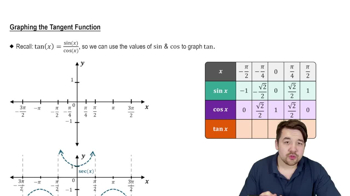
Period of the Tangent Function
The tangent function has a fundamental period of π, meaning its values repeat every π units. For y = tan(x), one full period spans an interval of length π. When graphing two full periods, you need to cover an interval of length 2π along the x-axis.
Video consigliato:
Percorso guidato
Introduction to Tangent Graph
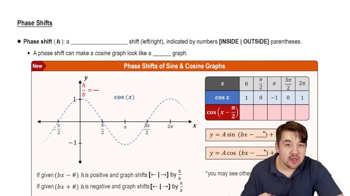
Phase Shift
A phase shift occurs when the input variable x is replaced by (x − c), shifting the graph horizontally by c units. In y = −tan(x − π/4), the graph is shifted π/4 units to the right. This affects the location of key features like asymptotes and zeros.
Video consigliato:
Percorso guidato
Phase Shifts
Reflection and Amplitude in Tangent Functions
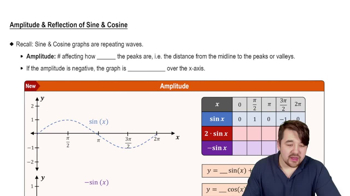
The negative sign in front of the tangent function, as in y = −tan(x − π/4), reflects the graph across the x-axis, reversing its increasing and decreasing behavior. Unlike sine and cosine, tangent has no amplitude since it is unbounded, but reflections affect the direction of the curve.
Video consigliato:
Percorso guidato
Amplitude and Reflection of Sine and Cosine
Pratica correlata
Domanda del libro di testo
874
views
Domanda del libro di testo
In Exercises 18–24, graph two full periods of the given tangent or cotangent function. y = −2 tan π/4 x
856
views
Domanda del libro di testo
In Exercises 17–30, determine the amplitude, period, and phase shift of each function. Then graph one period of the function. y = 3 sin(2x − π)
1001
views
Domanda del libro di testo
In Exercises 17–24, graph two periods of the given cotangent function. y = 3 cot(x + π/2)
855
views
Domanda del libro di testo
In Exercises 17–24, graph two periods of the given cotangent function. y = −3 cot π/2 x
815
views
Domanda del libro di testo
In Exercises 1–26, find the exact value of each expression. _ cot⁻¹ (−√3)
830
views