Ch. 2 - Graphs of the Trigonometric Functions; Inverse Trigonometric Functions
Blitzer - Trigonometry 3rd Edition
Blitzer3rd EditionTrigonometryISBN: 9780137316601Non è quello che usi tu?Cambia libro di testo
Capitolo 2, Problema 31

In Exercises 29–44, graph two periods of the given cosecant or secant function. y = 1/2 csc x/2

Guida verificata passo dopo passo
1
Identify the given function: \(y = \frac{1}{2} \csc \left( \frac{x}{2} \right)\).
Recall that the cosecant function \(\csc \theta\) is the reciprocal of the sine function, so \(\csc \theta = \frac{1}{\sin \theta}\).
Determine the period of the function inside the cosecant. The standard period of \(\csc x\) is \(2\pi\). Since the argument is \(\frac{x}{2}\), the period \(P\) is given by \(P = \frac{2\pi}{\frac{1}{2}} = 4\pi\).
Since the problem asks for two periods, calculate the interval for \(x\) to graph: from \(0\) to \(2 \times 4\pi = 8\pi\).
Plot the graph by first sketching the sine function \(y = \sin \left( \frac{x}{2} \right)\) over \([0, 8\pi]\), then draw the cosecant as the reciprocal of sine, scaled by \(\frac{1}{2}\), noting vertical asymptotes where \(\sin \left( \frac{x}{2} \right) = 0\).

Risposta video verificata per un problema simile:

Questa soluzione video è stata consigliata dai nostri tutor come utile per risolvere questo problema.
Durata del video:
15m

Concetti chiave

Ecco i concetti essenziali che devi comprendere per rispondere correttamente alla domanda.

Understanding the Cosecant Function

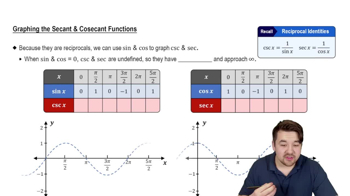
The cosecant function, csc(x), is the reciprocal of the sine function, defined as csc(x) = 1/sin(x). It is undefined where sin(x) = 0, leading to vertical asymptotes. Recognizing its periodicity and behavior near these asymptotes is essential for accurate graphing.
Video consigliato:
Percorso guidato
6:22
Graphs of Secant and Cosecant Functions

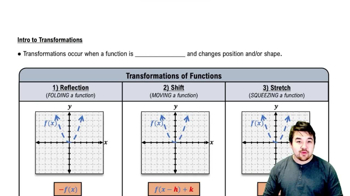
Effect of Transformations on Trigonometric Graphs

Transformations such as vertical scaling and horizontal stretching/compression alter the graph's shape and period. In y = (1/2) csc(x/2), the factor 1/2 scales the graph vertically, while the argument x/2 stretches the period horizontally, doubling it compared to the basic csc(x) function.
Video consigliato:
Percorso guidato
5:25
Introduction to Transformations

Period of the Cosecant Function

The period of the basic cosecant function is 2π, matching the sine function's period. When the input is modified to x/2, the period becomes 4π, calculated by dividing 2π by the coefficient of x inside the function. Knowing the period helps in plotting the correct length for two full cycles.
Video consigliato:
Percorso guidato
6:22
Graphs of Secant and Cosecant Functions