In Exercises 43–52, determine the amplitude, period, and phase shift of each function. Then graph one period of the function. y = 2 cos (2πx + 8π)
Ch. 2 - Graphs of the Trigonometric Functions; Inverse Trigonometric Functions

Tutti i libri di testo
Blitzer 3rd Edition
Ch. 2 - Graphs of the Trigonometric Functions; Inverse Trigonometric Functions
Problema 53
Blitzer 3rd Edition
Ch. 2 - Graphs of the Trigonometric Functions; Inverse Trigonometric Functions
Problema 53Capitolo 2, Problema 53
In Exercises 39–54, find the exact value of each expression, if possible. Do not use a calculator. sin(sin⁻¹ π)
Guida verificata passo dopo passo1
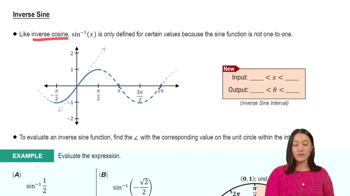
Recognize that the expression is \( \sin(\sin^{-1} \pi) \). The function \( \sin^{-1} \) (also called arcsin) is the inverse sine function, which returns an angle whose sine is the given value.
Recall the domain and range of the inverse sine function: \( \sin^{-1} x \) is defined only for \( x \) in the interval \( [-1, 1] \), and it returns an angle \( \theta \) in the range \( [-\frac{\pi}{2}, \frac{\pi}{2}] \).
Since \( \pi \approx 3.14159 \) is outside the domain \( [-1, 1] \) of \( \sin^{-1} \), the expression \( \sin^{-1} \pi \) is not defined in the real numbers.
Therefore, the expression \( \sin(\sin^{-1} \pi) \) cannot be evaluated as a real number because \( \sin^{-1} \pi \) does not exist in the real domain.
Conclude that the exact value of \( \sin(\sin^{-1} \pi) \) is undefined or does not exist in the real number system.

Risposta video verificata per un problema simile:
Questa soluzione video è stata consigliata dai nostri tutor come utile per risolvere questo problema.
Durata del video:
1mConcetti chiave
Ecco i concetti essenziali che devi comprendere per rispondere correttamente alla domanda.
Inverse Sine Function (sin⁻¹ or arcsin)
The inverse sine function, denoted sin⁻¹ or arcsin, returns the angle whose sine is a given number. Its output range is limited to [-π/2, π/2], meaning it only accepts inputs between -1 and 1 for real values.
Video consigliato:
Percorso guidato
Inverse Sine
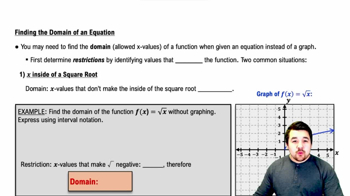
Domain Restrictions of the Sine Function
The sine function outputs values between -1 and 1, so its inverse function sin⁻¹ only accepts inputs within this range. If the input to sin⁻¹ is outside [-1, 1], the expression is undefined in the real number system.
Video consigliato:
Percorso guidato
Finding the Domain of an Equation
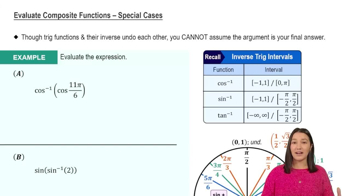
Evaluating Composite Trigonometric Expressions
When evaluating expressions like sin(sin⁻¹ x), if x is within the domain of sin⁻¹, the result simplifies to x. However, if x is outside the domain, the expression cannot be evaluated without extending to complex numbers.
Video consigliato:
Percorso guidato
Evaluate Composite Functions - Special Cases
Pratica correlata
Domanda del libro di testo
563
views
Domanda del libro di testo
In Exercises 53–54, let f(x) = 2 sec x, g(x) = −2 tan x, and h(x) = 2x − π/2. Graph two periods of y = (f∘h)(x).
733
views
Domanda del libro di testo
In Exercises 54–57, solve the right triangle shown in the figure. Round lengths to two decimal places and express angles to the nearest tenth of a degree. A = 22.3°, c = 10
657
views
Domanda del libro di testo
In Exercises 52–53, use a right triangle to write each expression as an algebraic expression. Assume that x is positive and that the given inverse trigonometric function is defined for the expression in x. sec(sin⁻¹ 1/x)
676
views
Domanda del libro di testo
In Exercises 53–60, use a vertical shift to graph one period of the function. y = sin x + 2
757
views
Domanda del libro di testo
In Exercises 39–54, find the exact value of each expression, if possible. Do not use a calculator. sin⁻¹ (sin π)
776
views