In Exercises 61–66, use the method of adding y-coordinates to graph each function for 0 ≤ x ≤ 2π. y = cos x + cos 2x
Ch. 2 - Graphs of the Trigonometric Functions; Inverse Trigonometric Functions

Tutti i libri di testo
Blitzer 3rd Edition
Ch. 2 - Graphs of the Trigonometric Functions; Inverse Trigonometric Functions
Problema 63
Blitzer 3rd Edition
Ch. 2 - Graphs of the Trigonometric Functions; Inverse Trigonometric Functions
Problema 63Capitolo 2, Problema 63
In Exercises 63–82, use a sketch to find the exact value of each expression. cos (sin⁻¹ 4/5)
Guida verificata passo dopo passo1
Recognize that the expression is \( \cos(\sin^{-1}(\frac{4}{5})) \). Here, \( \sin^{-1}(\frac{4}{5}) \) represents an angle \( \theta \) whose sine is \( \frac{4}{5} \). So, let \( \theta = \sin^{-1}(\frac{4}{5}) \), which means \( \sin \theta = \frac{4}{5} \).
Draw a right triangle to represent the angle \( \theta \). Since \( \sin \theta = \frac{\text{opposite}}{\text{hypotenuse}} = \frac{4}{5} \), label the side opposite to \( \theta \) as 4 and the hypotenuse as 5.
Use the Pythagorean theorem to find the adjacent side of the triangle. The formula is \( \text{adjacent} = \sqrt{\text{hypotenuse}^2 - \text{opposite}^2} = \sqrt{5^2 - 4^2} \).
Calculate the adjacent side length (do not simplify fully here, just set up the expression). This gives \( \sqrt{25 - 16} = \sqrt{9} \).
Now, find \( \cos \theta \) using the triangle sides: \( \cos \theta = \frac{\text{adjacent}}{\text{hypotenuse}} = \frac{\sqrt{9}}{5} \). This expression represents the exact value of \( \cos(\sin^{-1}(\frac{4}{5})) \).

Risposta video verificata per un problema simile:
Questa soluzione video è stata consigliata dai nostri tutor come utile per risolvere questo problema.
Durata del video:
3mConcetti chiave
Ecco i concetti essenziali che devi comprendere per rispondere correttamente alla domanda.
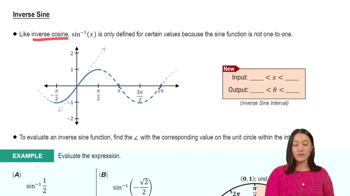
Inverse Sine Function (sin⁻¹ or arcsin)
The inverse sine function, sin⁻¹(x), returns the angle whose sine is x. It is defined for inputs between -1 and 1 and outputs angles in the range [-π/2, π/2]. Understanding this helps identify the angle corresponding to a given sine value.
Video consigliato:
Percorso guidato
Inverse Sine
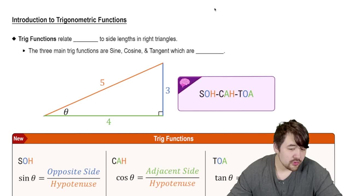
Right Triangle Interpretation of Trigonometric Functions
Trigonometric functions can be represented using right triangles, where sine is the ratio of the opposite side to the hypotenuse. Sketching a triangle with sin θ = 4/5 allows determination of other sides and angles, facilitating calculation of related trig values like cosine.
Video consigliato:
Percorso guidato
Introduction to Trigonometric Functions
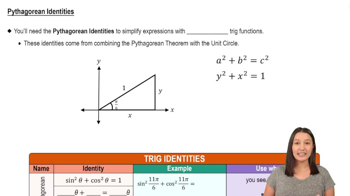
Pythagorean Identity
The Pythagorean identity states that sin²θ + cos²θ = 1 for any angle θ. This relationship allows calculation of cosine when sine is known by rearranging to cos θ = ±√(1 - sin²θ), with the sign determined by the angle's quadrant.
Video consigliato:
Percorso guidato
Pythagorean Identities
Pratica correlata
Domanda del libro di testo
734
views
Domanda del libro di testo
In Exercises 53–60, use a vertical shift to graph one period of the function. y = −3 sin 2πx + 2
832
views
Domanda del libro di testo
In Exercises 61–62, use the figures shown to find the bearing from O to A.
1054
views
Domanda del libro di testo
In Exercises 61–66, use the method of adding y-coordinates to graph each function for 0 ≤ x ≤ 2π. y = 3 cos x + sin x
615
views
Domanda del libro di testo
In Exercises 65–66, an object moves in simple harmonic motion described by the given equation, where t is measured in seconds and d in centimeters. In each exercise, find: a. the maximum displacement b. the frequency c. the time required for one cycle. d = 20 cos π/4 t
800
views
Domanda del libro di testo
In Exercises 63–82, use a sketch to find the exact value of each expression. tan (cos⁻¹ 5/13)
716
views