In Exercises 61–66, use the method of adding y-coordinates to graph each function for 0 ≤ x ≤ 2π. y = cos x + cos 2x
Ch. 2 - Graphs of the Trigonometric Functions; Inverse Trigonometric Functions

Tutti i libri di testo
Blitzer 3rd Edition
Ch. 2 - Graphs of the Trigonometric Functions; Inverse Trigonometric Functions
Problema 65
Blitzer 3rd Edition
Ch. 2 - Graphs of the Trigonometric Functions; Inverse Trigonometric Functions
Problema 65Capitolo 2, Problema 65
In Exercises 65–66, an object moves in simple harmonic motion described by the given equation, where t is measured in seconds and d in centimeters. In each exercise, find: a. the maximum displacement b. the frequency c. the time required for one cycle. d = 20 cos π/4 t
Guida verificata passo dopo passo1
Identify the given equation of simple harmonic motion: \(d = 20 \cos \left( \frac{\pi}{4} t \right)\), where \(d\) is displacement in centimeters and \(t\) is time in seconds.
To find the maximum displacement, recognize that the amplitude of the motion is the coefficient in front of the cosine function. So, the maximum displacement is the absolute value of this coefficient.
To find the frequency, recall that the general form of simple harmonic motion is \(d = A \cos(\omega t)\), where \(\omega\) is the angular frequency in radians per second. Identify \(\omega\) from the equation and use the relation \(f = \frac{\omega}{2\pi}\) to find the frequency in hertz (cycles per second).
To find the time required for one cycle (the period), use the formula \(T = \frac{1}{f}\), where \(T\) is the period in seconds and \(f\) is the frequency found in the previous step.
Summarize the results: maximum displacement is the amplitude, frequency is calculated from angular frequency, and period is the reciprocal of frequency.

Risposta video verificata per un problema simile:
Questa soluzione video è stata consigliata dai nostri tutor come utile per risolvere questo problema.
Durata del video:
4mConcetti chiave
Ecco i concetti essenziali che devi comprendere per rispondere correttamente alla domanda.
Simple Harmonic Motion (SHM)
Simple Harmonic Motion describes oscillatory motion where the restoring force is proportional to displacement and acts in the opposite direction. The displacement varies sinusoidally with time, typically modeled by equations like d = A cos(ωt), where A is amplitude and ω is angular frequency.
Video consigliato:
Percorso guidato
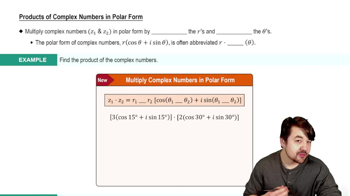
Products of Complex Numbers in Polar Form
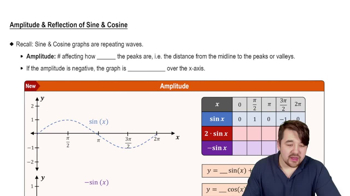
Amplitude and Maximum Displacement
Amplitude is the maximum displacement from the equilibrium position in SHM. It represents the peak value of the cosine or sine function in the motion equation, indicating how far the object moves from its central position.
Video consigliato:
Percorso guidato
Amplitude and Reflection of Sine and Cosine
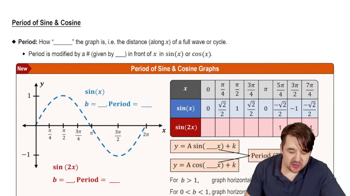
Frequency and Period of Oscillation
Frequency is the number of complete oscillations per second, measured in hertz (Hz), and is related to angular frequency ω by f = ω/(2π). The period is the time for one full cycle, given by T = 1/f, representing how long the object takes to repeat its motion.
Video consigliato:
Percorso guidato
Period of Sine and Cosine Functions
Pratica correlata
Domanda del libro di testo
734
views
Domanda del libro di testo
In Exercises 63–82, use a sketch to find the exact value of each expression. cos (sin⁻¹ 4/5)
658
views
Domanda del libro di testo
In Exercises 63–82, use a sketch to find the exact value of each expression. tan [sin⁻¹ (− 3/5)]
697
views
Domanda del libro di testo
In Exercises 67–68, an object is attached to a coiled spring. In Exercise 67, the object is pulled down (negative direction from the rest position) and then released. In Exercise 68, the object is propelled downward from its rest position. Write an equation for the distance of the object from its rest position after t seconds.
747
views
Domanda del libro di testo
In Exercises 61–66, use the method of adding y-coordinates to graph each function for 0 ≤ x ≤ 2π. y = cos x + sin 2x
687
views
Domanda del libro di testo
In Exercises 63–82, use a sketch to find the exact value of each expression. tan (cos⁻¹ 5/13)
716
views