In Exercises 63–82, use a sketch to find the exact value of each expression. cot (csc⁻¹ 8)
Ch. 2 - Graphs of the Trigonometric Functions; Inverse Trigonometric Functions

Tutti i libri di testo
Blitzer 3rd Edition
Ch. 2 - Graphs of the Trigonometric Functions; Inverse Trigonometric Functions
Problema 77
Blitzer 3rd Edition
Ch. 2 - Graphs of the Trigonometric Functions; Inverse Trigonometric Functions
Problema 77Capitolo 2, Problema 77
In Exercises 63–82, use a sketch to find the exact value of each expression. cos [tan⁻¹ (− 2/3)]
Guida verificata passo dopo passo1
Recognize that the expression involves the cosine of an inverse tangent function: \(\cos\left(\tan^{-1}\left(-\frac{2}{3}\right)\right)\). This means we need to find the cosine of an angle whose tangent is \(-\frac{2}{3}\).
Let \(\theta = \tan^{-1}\left(-\frac{2}{3}\right)\). By definition, \(\tan(\theta) = -\frac{2}{3}\). We can think of \(\theta\) as an angle in a right triangle where the opposite side is \(-2\) and the adjacent side is \(3\) (the negative sign indicates direction, which affects the quadrant).
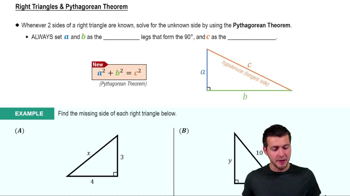
Use the Pythagorean theorem to find the hypotenuse \(r\) of the triangle: \(r = \sqrt{(3)^2 + (-2)^2} = \sqrt{9 + 4} = \sqrt{13}\).
Recall that \(\cos(\theta) = \frac{\text{adjacent}}{\text{hypotenuse}}\). Using the triangle sides, \(\cos(\theta) = \frac{3}{\sqrt{13}}\). Consider the sign of cosine based on the quadrant of \(\theta\) (since tangent is negative, \(\theta\) lies in either the second or fourth quadrant).
Determine the correct sign of \(\cos(\theta)\) based on the quadrant and write the exact value of \(\cos\left(\tan^{-1}\left(-\frac{2}{3}\right)\right)\) as \(\pm \frac{3}{\sqrt{13}}\) accordingly.

Risposta video verificata per un problema simile:
Questa soluzione video è stata consigliata dai nostri tutor come utile per risolvere questo problema.
Durata del video:
3mConcetti chiave
Ecco i concetti essenziali che devi comprendere per rispondere correttamente alla domanda.
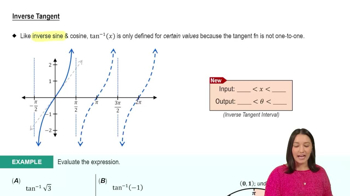
Inverse Tangent Function (tan⁻¹ or arctan)
The inverse tangent function returns the angle whose tangent is a given number. For tan⁻¹(−2/3), it gives an angle in the range of −π/2 to π/2 whose tangent is −2/3. Understanding this helps in interpreting the angle involved in the problem.
Video consigliato:
Percorso guidato
Inverse Tangent
Right Triangle Representation of Trigonometric Ratios
Trigonometric functions can be represented using right triangles, where the sides correspond to ratios like opposite, adjacent, and hypotenuse. For tan⁻¹(−2/3), a triangle with opposite side −2 and adjacent side 3 can be sketched to find the hypotenuse and then calculate cosine.
Video consigliato:
Percorso guidato
Solving Right Triangles with the Pythagorean Theorem
Relationship Between Tangent and Cosine
Cosine of an angle can be found using the sides of the right triangle: cos(θ) = adjacent/hypotenuse. Given tan(θ) = opposite/adjacent, once the hypotenuse is found using the Pythagorean theorem, cosine can be calculated exactly.
Video consigliato:
Percorso guidato
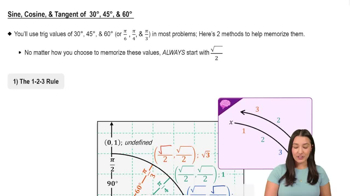
Sine, Cosine, & Tangent of 30°, 45°, & 60°
Pratica correlata
Domanda del libro di testo
688
views
Domanda del libro di testo
In Exercises 63–82, use a sketch to find the exact value of each expression. tan [cos⁻¹ (− 1/3)]
853
views
Domanda del libro di testo
In Exercises 79–82, graph f, g, and h in the same rectangular coordinate system for 0 ≤ x ≤ 2π. Obtain the graph of h by adding or subtracting the corresponding y-coordinates on the graphs of f and g. f(x) = 2 cos x, g(x) = cos 2x, h(x) = (f + g)(x)
647
views
Domanda del libro di testo
In Exercises 75–78, graph one period of each function. y = |2 cos x/2|
558
views
Domanda del libro di testo
In Exercises 79–82, graph f, g, and h in the same rectangular coordinate system for 0 ≤ x ≤ 2π. Obtain the graph of h by adding or subtracting the corresponding y-coordinates on the graphs of f and g. f(x) = cos x, g(x) = sin 2x, h(x) = (f − g)(x)
657
views
Domanda del libro di testo
In Exercises 75–78, graph one period of each function. y = −|3 sin πx|
536
views