Ch. 2 - Graphs of the Trigonometric Functions; Inverse Trigonometric Functions
Blitzer - Trigonometry 3rd Edition
Blitzer3rd EditionTrigonometryISBN: 9780137316601Non è quello che usi tu?Cambia libro di testo
Capitolo 2, Problema 80

In Exercises 79–82, graph f, g, and h in the same rectangular coordinate system for 0 ≤ x ≤ 2π. Obtain the graph of h by adding or subtracting the corresponding y-coordinates on the graphs of f and g. f(x) = 2 cos x, g(x) = cos 2x, h(x) = (f + g)(x)

Guida verificata passo dopo passo
1
Identify the given functions: \(f(x) = 2 \cos x\), \(g(x) = \cos 2x\), and \(h(x) = (f + g)(x) = f(x) + g(x)\).
Understand that to graph \(h(x)\), you need to add the corresponding \(y\)-values of \(f(x)\) and \(g(x)\) for each \(x\) in the interval \(0 \leq x \leq 2\pi\).
Create a table of values for \(x\) at key points within \(0\) to \(2\pi\) (such as \(0\), \(\frac{\pi}{2}\), \(\pi\), \(\frac{3\pi}{2}\), and \(2\pi\)). Calculate \(f(x)\) and \(g(x)\) at each of these points.
Add the values from \(f(x)\) and \(g(x)\) at each \(x\) to find \(h(x)\), i.e., compute \(h(x) = 2 \cos x + \cos 2x\) for each \(x\).
Plot the points for \(f(x)\), \(g(x)\), and \(h(x)\) on the same coordinate system and draw smooth curves through these points to visualize how \(h(x)\) is formed by adding the graphs of \(f\) and \(g\).

Risposta video verificata per un problema simile:

Questa soluzione video è stata consigliata dai nostri tutor come utile per risolvere questo problema.
Durata del video:
6m

Concetti chiave

Ecco i concetti essenziali che devi comprendere per rispondere correttamente alla domanda.

Graphing Trigonometric Functions

Graphing trigonometric functions involves plotting their values over a specified domain, such as 0 to 2π. Understanding the shape, period, amplitude, and phase shift of functions like cosine helps visualize their behavior and compare multiple functions on the same coordinate system.
Video consigliato:
Percorso guidato
6:04
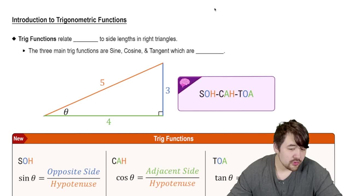
Introduction to Trigonometric Functions

Function Addition and Pointwise Operations

Adding functions means combining their outputs for each input value. For h(x) = f(x) + g(x), the y-coordinate of h at any x is the sum of the y-coordinates of f and g at that x. This concept is essential for constructing the graph of h from f and g.
Video consigliato:
Percorso guidato
04:12
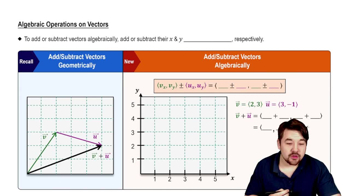
Algebraic Operations on Vectors

Properties of Cosine Functions and Frequency

Cosine functions like cos x and cos 2x differ in frequency; cos 2x completes two cycles in the interval 0 to 2π, while cos x completes one. Recognizing how frequency affects the graph's oscillations is crucial for accurately plotting and combining these functions.
Video consigliato:
Percorso guidato
5:53
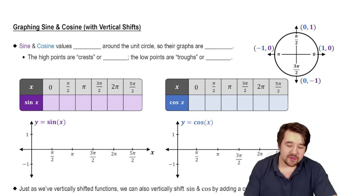
Graph of Sine and Cosine Function