Ch. 2 - Graphs of the Trigonometric Functions; Inverse Trigonometric Functions
Blitzer - Trigonometry 3rd Edition
Blitzer3rd EditionTrigonometryISBN: 9780137316601Non è quello che usi tu?Cambia libro di testo
Capitolo 2, Problema 94

In Exercises 83–94, use a right triangle to write each expression as an algebraic expression. Assume that x is positive and that the given inverse trigonometric function is defined for the expression in x. csc (cot⁻¹ x)

Guida verificata passo dopo passo
1
Recognize that the expression is \( \csc(\cot^{-1} x) \). Let \( \theta = \cot^{-1} x \), which means \( \cot \theta = x \).
Recall that \( \cot \theta = \frac{\text{adjacent}}{\text{opposite}} \). Since \( x > 0 \), we can represent the right triangle with adjacent side = \( x \) and opposite side = 1.
Use the Pythagorean theorem to find the hypotenuse: \( \text{hypotenuse} = \sqrt{x^2 + 1^2} = \sqrt{x^2 + 1} \).
Recall that \( \csc \theta = \frac{\text{hypotenuse}}{\text{opposite}} \). Substitute the values from the triangle: \( \csc \theta = \frac{\sqrt{x^2 + 1}}{1} \).
Therefore, \( \csc(\cot^{-1} x) = \sqrt{x^2 + 1} \), which is the algebraic expression in terms of \( x \).

Risposta video verificata per un problema simile:

Questa soluzione video è stata consigliata dai nostri tutor come utile per risolvere questo problema.
Durata del video:
3m

Concetti chiave

Ecco i concetti essenziali che devi comprendere per rispondere correttamente alla domanda.

Inverse Trigonometric Functions

Inverse trigonometric functions, like cot⁻¹(x), return an angle whose trigonometric ratio equals x. Understanding how to interpret these functions is essential for converting expressions involving inverse trig functions into geometric or algebraic forms.
Video consigliato:
Percorso guidato
4:28
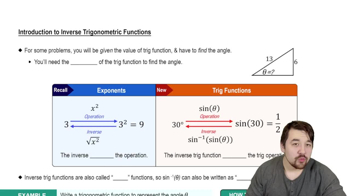
Introduction to Inverse Trig Functions

Right Triangle Definitions of Trigonometric Ratios

Trigonometric ratios such as sine, cosine, cotangent, and cosecant can be represented as ratios of sides in a right triangle. Using a right triangle helps visualize and rewrite expressions like csc(cot⁻¹ x) in terms of side lengths and algebraic expressions.
Video consigliato:
Percorso guidato
5:19
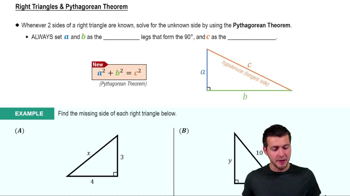
Solving Right Triangles with the Pythagorean Theorem

Relationship Between Cotangent and Cosecant

Cotangent is the ratio of adjacent to opposite sides, while cosecant is the reciprocal of sine (hypotenuse over opposite). Understanding how to express csc(θ) when θ = cot⁻¹(x) involves using the Pythagorean theorem to find the hypotenuse and then forming the correct ratio.
Video consigliato:
Percorso guidato
6:22
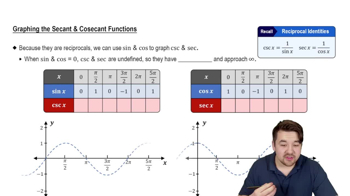
Graphs of Secant and Cosecant Functions
Pratica correlata
Domanda del libro di testo

In Exercises 83–94, use a right triangle to write each expression as an algebraic expression. Assume that x is positive and that the given inverse trigonometric function is defined for the expression in x. sec (cos⁻¹ 1/x)

698
views
Domanda del libro di testo

The graphs of y = sin⁻¹ x, y = cos⁻¹ x, and y = tan⁻¹ x are shown in Table 2.8. In Exercises 97–106, use transformations (vertical shifts, horizontal shifts, reflections, stretching, or shrinking) of these graphs to graph each function. Then use interval notation to give the function's domain and range. f(x) = sin⁻¹ x + π/2

690
views
Domanda del libro di testo

The graphs of y = sin⁻¹ x, y = cos⁻¹ x, and y = tan⁻¹ x are shown in Table 2.8. In Exercises 97–106, use transformations (vertical shifts, horizontal shifts, reflections, stretching, or shrinking) of these graphs to graph each function. Then use interval notation to give the function's domain and range. f(x) = cos⁻¹ (x + 1)

749
views
Domanda del libro di testo

The graphs of y = sin⁻¹ x, y = cos⁻¹ x, and y = tan⁻¹ x are shown in Table 2.8. In Exercises 97–106, use transformations (vertical shifts, horizontal shifts, reflections, stretching, or shrinking) of these graphs to graph each function. Then use interval notation to give the function's domain and range. h(x) = −2 tan⁻¹ x

760
views
Domanda del libro di testo

In Exercises 83–94, use a right triangle to write each expression as an algebraic expression. Assume that x is positive and that the given inverse trigonometric function is defined for the expression in x. ___ sec (sin⁻¹ x/√x²+4)

821
views
Domanda del libro di testo

In Exercises 83–94, use a right triangle to write each expression as an algebraic expression. Assume that x is positive and that the given inverse trigonometric function is defined for the expression in x. cos (sin⁻¹ 1/x)

809
views