Ch. 2 - Graphs of the Trigonometric Functions; Inverse Trigonometric Functions
Blitzer - Trigonometry 3rd Edition
Blitzer3rd EditionTrigonometryISBN: 9780137316601Non è quello che usi tu?Cambia libro di testo
Capitolo 2, Problema 101

The graphs of y = sin⁻¹ x, y = cos⁻¹ x, and y = tan⁻¹ x are shown in Table 2.8. In Exercises 97–106, use transformations (vertical shifts, horizontal shifts, reflections, stretching, or shrinking) of these graphs to graph each function. Then use interval notation to give the function's domain and range. h(x) = −2 tan⁻¹ x

Guida verificata passo dopo passo
1
Identify the base function given, which is the inverse tangent function \(y = \tan^{-1} x\). Recall that its standard domain is \((-\infty, \infty)\) and its range is \(\left(-\frac{\pi}{2}, \frac{\pi}{2}\right)\).
Analyze the transformation applied to the base function. The function is \(h(x) = -2 \tan^{-1} x\), which involves two transformations: a vertical stretch by a factor of 2 and a reflection about the x-axis (due to the negative sign).
Apply the vertical stretch and reflection to the range of \(\tan^{-1} x\). Since the original range is \(\left(-\frac{\pi}{2}, \frac{\pi}{2}\right)\), multiplying by -2 will stretch the range by 2 and flip it, so the new range will be \(\left(-2 \times \frac{\pi}{2}, -2 \times -\frac{\pi}{2}\right)\).
Note that the domain of \(\tan^{-1} x\) is all real numbers, and since the transformation only affects the output (y-values), the domain of \(h(x)\) remains \((-\infty, \infty)\).
Summarize the domain and range in interval notation after applying the transformations, and sketch the graph by reflecting and stretching the original \(\tan^{-1} x\) graph accordingly.

Risposta video verificata per un problema simile:

Questa soluzione video è stata consigliata dai nostri tutor come utile per risolvere questo problema.
Durata del video:
10m

Concetti chiave

Ecco i concetti essenziali che devi comprendere per rispondere correttamente alla domanda.

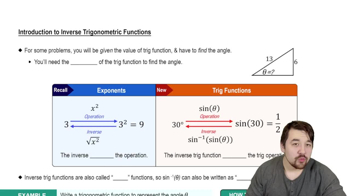
Inverse Trigonometric Functions

Inverse trigonometric functions like sin⁻¹x, cos⁻¹x, and tan⁻¹x return the angle whose trigonometric ratio equals x. They have specific domains and ranges, for example, tan⁻¹x has domain all real numbers and range (−π/2, π/2). Understanding these functions is essential for graphing and interpreting their transformations.
Video consigliato:
Percorso guidato
4:28
Introduction to Inverse Trig Functions

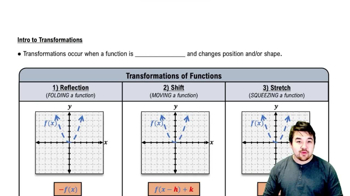
Graph Transformations

Graph transformations include vertical and horizontal shifts, reflections, stretches, and shrinks. For h(x) = −2 tan⁻¹ x, the negative sign reflects the graph across the x-axis, and the factor 2 vertically stretches it by a factor of 2. Recognizing how these changes affect the graph helps in sketching and analyzing the function.
Video consigliato:
Percorso guidato
5:25
Introduction to Transformations

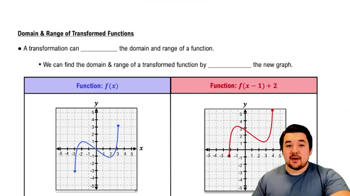
Domain and Range of Transformed Functions

The domain of inverse trig functions often remains unchanged under vertical transformations, but the range changes according to vertical stretches or reflections. For h(x) = −2 tan⁻¹ x, the domain is all real numbers, while the range is the original range (−π/2, π/2) scaled and reflected, resulting in (−π, π). Using interval notation accurately describes these sets.
Video consigliato:
Percorso guidato
4:22
Domain and Range of Function Transformations