Ch. 2 - Graphs of the Trigonometric Functions; Inverse Trigonometric Functions
Blitzer - Trigonometry 3rd Edition
Blitzer3rd EditionTrigonometryISBN: 9780137316601Non è quello che usi tu?Cambia libro di testo
Capitolo 2, Problema 13

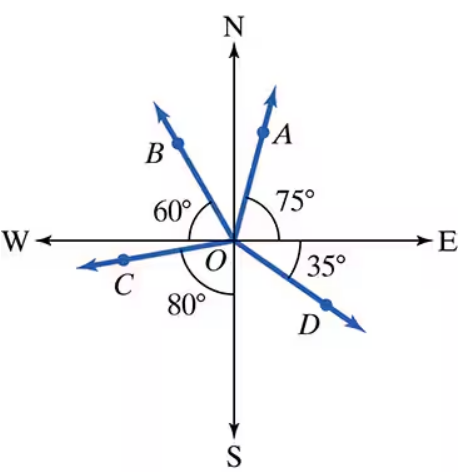
Find the bearing from O to A.

Guida verificata passo dopo passo
1
Identify the reference direction for bearings, which is always measured clockwise from the north (N) direction.
Locate point A on the diagram. Since the problem asks for the bearing from O to A, and the diagram shows points P, Q, R, and S, confirm if point A corresponds to one of these points or if it is missing from the image. If point A is not shown, clarify or check the problem statement again.
If point A corresponds to one of the points shown (for example, Q, R, P, or S), use the given angles to calculate the bearing. Bearings are measured clockwise from north, so start from the north line and move clockwise to the line pointing to the point.
For example, if point A corresponds to point Q, the bearing from O to Q is given directly as 61° clockwise from north.
If point A corresponds to another point, add or subtract the given angles accordingly to find the clockwise angle from north to the line pointing to A. This angle is the bearing from O to A.

Risposta video verificata per un problema simile:

Questa soluzione video è stata consigliata dai nostri tutor come utile per risolvere questo problema.
Durata del video:
2m

Concetti chiave

Ecco i concetti essenziali che devi comprendere per rispondere correttamente alla domanda.

Understanding Bearings

Bearings are a way to describe direction using degrees measured clockwise from the north line. They range from 0° to 360°, with north as 0° or 360°, east as 90°, south as 180°, and west as 270°. Bearings help in navigation and locating points relative to a reference direction.
Video consigliato:

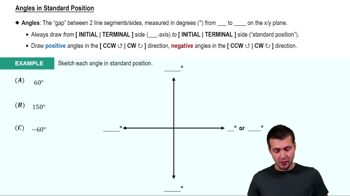
Using Angles in Standard Position

Angles in standard position are measured from the positive x-axis (east) counterclockwise. In navigation, angles are often given relative to north or south lines, so converting between these references is essential. Understanding how to add or subtract angles based on quadrant location is key to finding bearings.
Video consigliato:
Percorso guidato
05:50
Drawing Angles in Standard Position

Interpreting Diagrams with Compass Directions

Diagrams with compass directions show points and angles relative to north, east, south, and west. Recognizing how angles relate to these directions allows you to calculate bearings accurately. For example, an angle given from the west line can be converted to a bearing by considering its position clockwise from north.
Video consigliato:
Percorso guidato
05:13
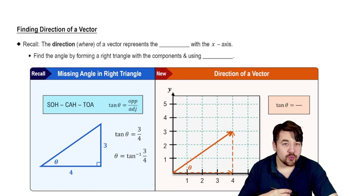
Finding Direction of a Vector