Domanda del libro di testo
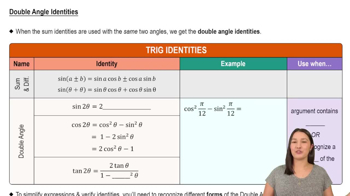
In Exercises 39–42, use double- and half-angle formulas to find the exact value of each expression. sin 22.5°
729
views

 Blitzer 3rd EditionCh. 3 - Trigonometric Identities and EquationsProblema 3.RE.62
 Guida verificata passo dopo passo
 05:06
05:06
 4:34
4:34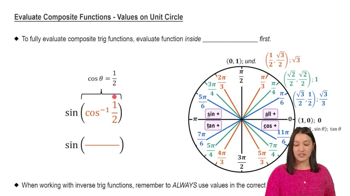 5:10
5:10In Exercises 39–42, use double- and half-angle formulas to find the exact value of each expression. sin 22.5°
In Exercises 35–38, find the exact value of the following under the given conditions:
b. cos(α﹣β)
sin α = -1/3, 𝝅 < α < 3𝝅/2, and cos β = -1/3, 𝝅 < β < 3𝝅/2.
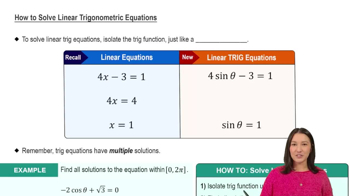
In Exercises 54–67, solve each equation on the interval [0, 2𝝅). Use exact values where possible or give approximate solutions correct to four decimal places. cos 2x = -1
In Exercises 35–38, find the exact value of the following under the given conditions:
a. sin(α + β)
sin α = 3/5, 0 < α < 𝝅/2, and sin β = 12/13, 𝝅/2 < β < 𝝅.
In Exercises 35–38, find the exact value of the following under the given conditions: b. cos(α﹣β)
sin α = 3/5, 0 < α < 𝝅/2, and sin β = 12/13, 𝝅/2 < β < 𝝅.
In Exercises 50–53, find all solutions of each equation. cos x = ﹣1/2