Ch. 3 - Trigonometric Identities and Equations
Blitzer - Trigonometry 3rd Edition
Blitzer3rd EditionTrigonometryISBN: 9780137316601Non è quello che usi tu?Cambia libro di testo
Capitolo 3, Problema 65

In Exercises 54–67, solve each equation on the interval [0, 2𝝅). Use exact values where possible or give approximate solutions correct to four decimal places. 5 cos² x - 3 = 0

Guida verificata passo dopo passo
1
Start with the given equation: \(5 \cos^{2} x - 3 = 0\).
Isolate the cosine squared term by adding 3 to both sides: \(5 \cos^{2} x = 3\).
Divide both sides by 5 to solve for \(\cos^{2} x\): \(\cos^{2} x = \frac{3}{5}\).
Take the square root of both sides to solve for \(\cos x\): \(\cos x = \pm \sqrt{\frac{3}{5}}\).
Find all values of \(x\) in the interval \([0, 2\pi)\) where \(\cos x = \sqrt{\frac{3}{5}}\) and where \(\cos x = -\sqrt{\frac{3}{5}}\), using the unit circle or inverse cosine function.

Risposta video verificata per un problema simile:

Questa soluzione video è stata consigliata dai nostri tutor come utile per risolvere questo problema.
Durata del video:
7m

Concetti chiave

Ecco i concetti essenziali che devi comprendere per rispondere correttamente alla domanda.

Solving Quadratic Trigonometric Equations

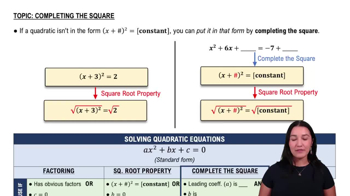
This involves treating trigonometric equations like algebraic quadratics by substituting expressions such as cos²x with a variable. After solving the quadratic equation, substitute back to find the trigonometric values and then solve for the angle x within the given interval.
Video consigliato:
Percorso guidato
6:24
Solving Quadratic Equations by Completing the Square

Unit Circle and Interval Restrictions

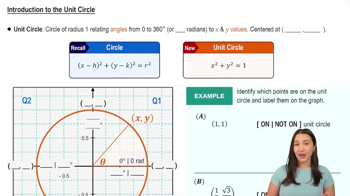
Understanding the unit circle helps identify all angle solutions for trigonometric equations within a specified interval, here [0, 2π). Since cosine values repeat every 2π, solutions must be found within one full rotation, considering both positive and negative cosine values.
Video consigliato:
Percorso guidato
06:11
Introduction to the Unit Circle

Exact Values and Approximate Solutions

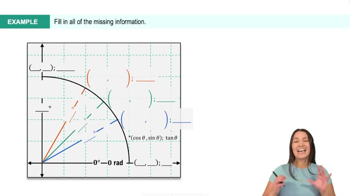
Exact values refer to well-known trigonometric values expressed in terms of π or simple fractions, while approximate solutions use decimal values rounded to a specified precision. Knowing when and how to use each is essential for providing answers as required by the problem.
Video consigliato: