Ch. 3 - Trigonometric Identities and Equations
Blitzer - Trigonometry 3rd Edition
Blitzer3rd EditionTrigonometryISBN: 9780137316601Non è quello che usi tu?Cambia libro di testo
Capitolo 3, Problema 64b

In Exercises 57–64, find the exact value of the following under the given conditions: b. sin (α + β), sin α = 5/6 , 𝝅/2 < α < 𝝅 , and tan β = 3/7 , 𝝅 < β < 3𝝅/2 .

Guida verificata passo dopo passo
1
Identify the given information: \( \sin \alpha = \frac{5\pi}{6} \) with \( \frac{3\pi}{2} < \alpha < \pi \), and \( \tan \beta = \frac{3\pi}{2} \) with \( \frac{7\pi}{2} < \beta < \text{(missing upper bound)} \). Note that the interval for \( \alpha \) seems inconsistent since \( \frac{3\pi}{2} > \pi \). Verify the intervals and values carefully before proceeding.
Recall the formula for \( \sin(\alpha + \beta) \): \[ \sin(\alpha + \beta) = \sin \alpha \cos \beta + \cos \alpha \sin \beta \]
Since \( \sin \alpha \) is given, find \( \cos \alpha \) using the Pythagorean identity: \[ \cos \alpha = \pm \sqrt{1 - \sin^2 \alpha} \] Determine the correct sign of \( \cos \alpha \) based on the quadrant where \( \alpha \) lies.
Use the given \( \tan \beta \) to find \( \sin \beta \) and \( \cos \beta \). Recall that: \[ \tan \beta = \frac{\sin \beta}{\cos \beta} \] Use the Pythagorean identity to express \( \sin \beta \) and \( \cos \beta \) in terms of \( \tan \beta \), and determine their signs based on the quadrant of \( \beta \).
Substitute the values of \( \sin \alpha \), \( \cos \alpha \), \( \sin \beta \), and \( \cos \beta \) into the formula for \( \sin(\alpha + \beta) \) and simplify to find the exact value.

Risposta video verificata per un problema simile:

Questa soluzione video è stata consigliata dai nostri tutor come utile per risolvere questo problema.
Durata del video:
7m

Concetti chiave

Ecco i concetti essenziali che devi comprendere per rispondere correttamente alla domanda.

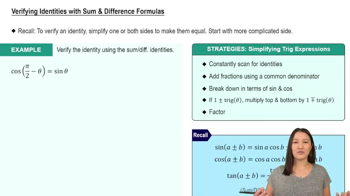
Sum of Angles Formula for Sine

The sum of angles formula states that sin(α + β) = sin α cos β + cos α sin β. This identity allows us to find the sine of a sum of two angles using the sines and cosines of the individual angles, which is essential when given trigonometric values of α and β separately.
Video consigliato:
Percorso guidato
2:25
Verifying Identities with Sum and Difference Formulas

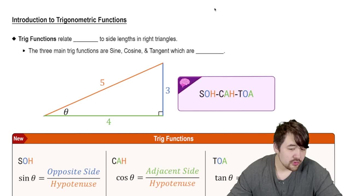
Determining the Sign of Trigonometric Functions Based on Quadrants

The signs of sine, cosine, and tangent depend on the quadrant in which the angle lies. Knowing the interval for α and β helps determine whether sine, cosine, or tangent values are positive or negative, which is crucial for correctly evaluating trigonometric expressions.
Video consigliato:
Percorso guidato
6:04
Introduction to Trigonometric Functions

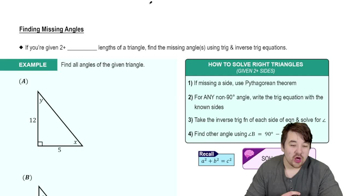
Using Given Trigonometric Ratios to Find Missing Values

Given sin α and tan β, we can use Pythagorean identities to find cos α and cos β. For example, cos α = ±√(1 - sin² α), with the sign determined by the quadrant. Similarly, from tan β, we find sin β and cos β using the identity tan β = sin β / cos β, enabling full evaluation of sin(α + β).
Video consigliato:
Percorso guidato
5:13
Finding Missing Angles