In Exercises 9–16, let
u = 2i - j, v = 3i + j, and w = i + 4j.
Find each specified scalar.
4(u ⋅ v)
Guida verificata passo dopo passo
1
First, recall the formula for the dot product of two vectors \( \mathbf{a} = a_1\mathbf{i} + a_2\mathbf{j} \) and \( \mathbf{b} = b_1\mathbf{i} + b_2\mathbf{j} \), which is \( \mathbf{a} \cdot \mathbf{b} = a_1b_1 + a_2b_2 \).
Substitute these components into the dot product formula: \( \mathbf{u} \cdot \mathbf{v} = (2)(3) + (-1)(1) \).
Calculate the expression inside the parentheses: \( 2 \times 3 + (-1) \times 1 \).
Finally, multiply the result of the dot product by 4 as specified: \( 4(\mathbf{u} \cdot \mathbf{v}) \).
Risposta video verificata per un problema simile:
Questa soluzione video è stata consigliata dai nostri tutor come utile per risolvere questo problema.
Durata del video:
2m
Guarda un video:
0 Commenti
Concetti chiave
Ecco i concetti essenziali che devi comprendere per rispondere correttamente alla domanda.
Dot Product
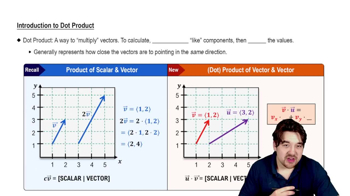
The dot product is a fundamental operation in vector algebra that takes two vectors and returns a scalar. It is calculated by multiplying the corresponding components of the vectors and summing the results. For vectors u = ai + bj and v = ci + dj, the dot product is given by u ⋅ v = ac + bd. This operation is crucial for determining the angle between vectors and for projecting one vector onto another.
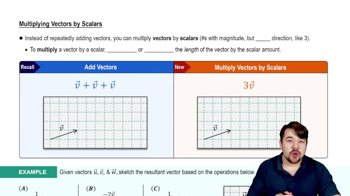
Scalar multiplication involves multiplying a vector by a scalar (a single number), which scales the vector's magnitude without changing its direction. If k is a scalar and v is a vector, then k * v results in a new vector whose length is k times that of v. This concept is essential when manipulating vectors in various operations, including scaling the result of the dot product.
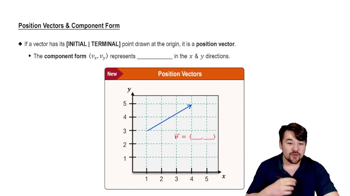
Vectors in a two-dimensional space can be expressed in terms of their components along the x-axis and y-axis. For example, a vector u = ai + bj has components a and b, where 'i' represents the unit vector in the x-direction and 'j' in the y-direction. Understanding vector components is vital for performing operations like the dot product, as it allows for the straightforward application of the formula using the individual components of the vectors.


 Guida verificata passo dopo passo
 05:40
05:40