In Exercises 9–16, let
u = 2i - j, v = 3i + j, and w = i + 4j.
Find each specified scalar.
(4u) ⋅ v
Guida verificata passo dopo passo
1
Step 1: Understand the problem. We need to find the dot product of the vector 4u with vector v.
Step 2: Calculate 4u by multiplying each component of vector u by 4. Given u = 2i - j, then 4u = 4(2i - j) = 8i - 4j.
Step 3: Write down vector v, which is given as v = 3i + j.
Step 4: Use the dot product formula: If a = ai + bj and b = ci + dj, then a ⋅ b = ac + bd.
Step 5: Substitute the components of 4u and v into the dot product formula: (8i - 4j) ⋅ (3i + j) = (8)(3) + (-4)(1).
Risposta video verificata per un problema simile:
Questa soluzione video è stata consigliata dai nostri tutor come utile per risolvere questo problema.
Durata del video:
2m
Guarda un video:
0 Commenti
Concetti chiave
Ecco i concetti essenziali che devi comprendere per rispondere correttamente alla domanda.
Vector Operations
Understanding vector operations is crucial in this problem. Vectors can be added, subtracted, and multiplied by scalars. In this case, the vector u is being multiplied by the scalar 4, which scales the vector's magnitude while maintaining its direction. This operation is foundational for further calculations involving dot products.
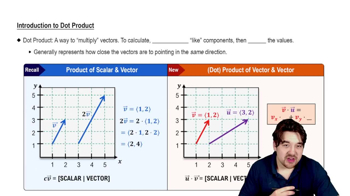
The dot product is a key operation in vector algebra that combines two vectors to produce a scalar. It is calculated by multiplying corresponding components of the vectors and summing the results. The dot product provides insights into the angle between vectors and is essential for determining orthogonality and projection.
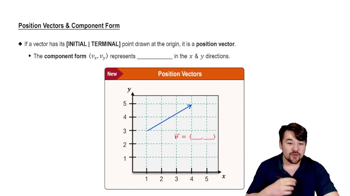
Vectors are often expressed in component form, which involves breaking them down into their respective i (horizontal) and j (vertical) components. For example, the vector u = 2i - j has components 2 and -1. Understanding this representation is vital for performing operations like the dot product, as it allows for straightforward calculations using the individual components.


 Guida verificata passo dopo passo

 04:12
04:12