Ch. 5 - Complex Numbers, Polar Coordinates and Parametric Equations
Blitzer - Trigonometry 3rd Edition
Blitzer3rd EditionTrigonometryISBN: 9780137316601Non è quello che usi tu?Cambia libro di testo
Capitolo 5, Problema 19

In Exercises 19–21, find the product of the complex numbers. Leave answers in polar form.
z₁ = 3(cos 40°+i sin 40°)
z₂ = 5(cos 70°+i sin 70°)

Guida verificata passo dopo passo
1
Recall that when multiplying two complex numbers in polar form, the magnitudes multiply and the angles add. Specifically, if \( z_1 = r_1 (\cos \theta_1 + i \sin \theta_1) \) and \( z_2 = r_2 (\cos \theta_2 + i \sin \theta_2) \), then their product is \( z_1 z_2 = r_1 r_2 \left( \cos(\theta_1 + \theta_2) + i \sin(\theta_1 + \theta_2) \right) \).
Identify the magnitudes and angles from the given complex numbers: \( r_1 = 3 \), \( \theta_1 = 40^\circ \), \( r_2 = 5 \), and \( \theta_2 = 70^\circ \).
Multiply the magnitudes: calculate \( r = r_1 \times r_2 = 3 \times 5 \).
Add the angles: calculate \( \theta = \theta_1 + \theta_2 = 40^\circ + 70^\circ \).
Write the product in polar form using the results from the previous steps: \( z_1 z_2 = r \left( \cos \theta + i \sin \theta \right) \).

Risposta video verificata per un problema simile:

Questa soluzione video è stata consigliata dai nostri tutor come utile per risolvere questo problema.
Durata del video:
4m

Concetti chiave

Ecco i concetti essenziali che devi comprendere per rispondere correttamente alla domanda.

Polar Form of Complex Numbers

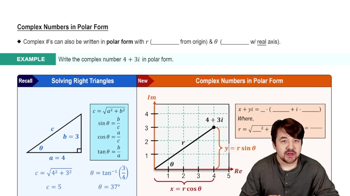
A complex number can be expressed in polar form as r(cos θ + i sin θ), where r is the magnitude (modulus) and θ is the argument (angle). This form is useful for multiplication and division because it separates the magnitude and angle components.
Video consigliato:
Percorso guidato
04:47
Complex Numbers In Polar Form

Multiplication of Complex Numbers in Polar Form

When multiplying two complex numbers in polar form, multiply their magnitudes and add their angles. Specifically, if z₁ = r₁(cos θ₁ + i sin θ₁) and z₂ = r₂(cos θ₂ + i sin θ₂), then z₁z₂ = r₁r₂ [cos(θ₁ + θ₂) + i sin(θ₁ + θ₂)].
Video consigliato:
Percorso guidato
04:47
Complex Numbers In Polar Form

Trigonometric Functions and Angle Addition

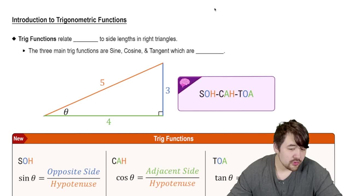
Understanding cosine and sine functions and how angles add is essential. The angle addition in the product uses the sum of the individual arguments, which relies on the properties of trigonometric functions to combine the angles correctly.
Video consigliato:
Percorso guidato
6:04
Introduction to Trigonometric Functions