In Exercises 11–20, use a polar coordinate system like the one shown for Exercises 1–10 to plot each point with the given polar coordinates. (−2, − π/2)
Ch. 5 - Complex Numbers, Polar Coordinates and Parametric Equations

Tutti i libri di testo
Blitzer 3rd Edition
Ch. 5 - Complex Numbers, Polar Coordinates and Parametric Equations
Problema 17
Blitzer 3rd Edition
Ch. 5 - Complex Numbers, Polar Coordinates and Parametric Equations
Problema 17Capitolo 5, Problema 17
In Exercises 13–34, test for symmetry and then graph each polar equation. r = 2 + 2 cos θ
Guida verificata passo dopo passo1
Identify the type of symmetry to test: polar equations can have symmetry with respect to the polar axis (x-axis), the line θ = π/2 (y-axis), or the pole (origin).
Test for symmetry with respect to the polar axis by replacing θ with -θ in the equation: r = 2 + 2 \(\cos\)(-θ). Since \(\cos\)(-θ) = \(\cos\)(θ), the equation remains unchanged, indicating symmetry with respect to the polar axis.
Test for symmetry with respect to the line θ = π/2 by replacing θ with π - θ: r = 2 + 2 \(\cos\)(π - θ). Since \(\cos\)(π - θ) = -\(\cos\)(θ), the equation changes, indicating no symmetry with respect to the line θ = π/2.
Test for symmetry with respect to the pole by replacing r with -r: -r = 2 + 2 \(\cos\)(θ). This does not simplify to the original equation, indicating no symmetry with respect to the pole.
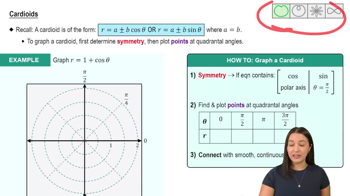
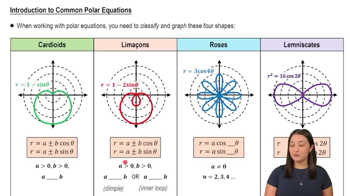
Graph the equation by plotting points for various values of θ, using the symmetry with respect to the polar axis to simplify the process. The graph will be a limaçon with an inner loop.

Risposta video verificata per un problema simile:
Questa soluzione video è stata consigliata dai nostri tutor come utile per risolvere questo problema.
Durata del video:
6mConcetti chiave
Ecco i concetti essenziali che devi comprendere per rispondere correttamente alla domanda.
Polar Coordinates
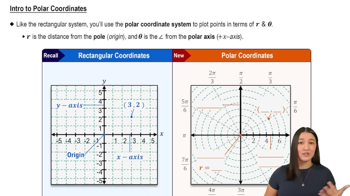
Polar coordinates represent points in a plane using a distance from a reference point (the pole) and an angle from a reference direction. In polar equations, 'r' denotes the radius (distance from the origin), and 'θ' represents the angle. Understanding how to convert between polar and Cartesian coordinates is essential for graphing polar equations.
Video consigliato:
Percorso guidato
Intro to Polar Coordinates
Symmetry in Polar Graphs
Symmetry in polar graphs can be tested by substituting specific values for θ. A graph is symmetric about the polar axis if replacing θ with -θ yields the same equation, and it is symmetric about the line θ = π/2 if replacing θ with π - θ gives the same result. Recognizing these symmetries helps in sketching the graph accurately.
Video consigliato:
Percorso guidato
Cardioids
Graphing Polar Equations
Graphing polar equations involves plotting points based on the values of 'r' for various angles 'θ'. The shape of the graph can vary significantly depending on the equation's form. For the equation r = 2 + 2 cos θ, understanding how to evaluate 'r' at key angles (like 0, π/2, π, and 3π/2) is crucial for accurately depicting the graph.
Video consigliato:
Percorso guidato
Introduction to Common Polar Equations
Pratica correlata
Domanda del libro di testo
702
views
Domanda del libro di testo
In Exercises 9–20, find each product and write the result in standard form.
(3 + 5i)(3 − 5i)
490
views
Domanda del libro di testo
In Exercises 15–18, write each complex number in rectangular form. If necessary, round to the nearest tenth. 6 (cos 2π/3 + i sin 2π/3)
500
views
Domanda del libro di testo
In Exercises 9–20, find each product and write the result in standard form. (−5 + i)(−5 − i)
734
views
Domanda del libro di testo
In Exercises 19–21, find the product of the complex numbers. Leave answers in polar form.
z₁ = 3(cos 40°+i sin 40°)
z₂ = 5(cos 70°+i sin 70°)
526
views
Domanda del libro di testo
In Exercises 11–20, use a polar coordinate system like the one shown for Exercises 1–10 to plot each point with the given polar coordinates. (−1, π)
684
views