In Exercises 21–40, eliminate the parameter t. Then use the rectangular equation to sketch the plane curve represented by the given parametric equations. Use arrows to show the orientation of the curve corresponding to increasing values of t. (If an interval for t is not specified, assume that −∞ < t < ∞. x = 2ᵗ, y = 2⁻ᵗ; t ≥ 0
Ch. 5 - Complex Numbers, Polar Coordinates and Parametric Equations

Tutti i libri di testo
Blitzer 3rd Edition
Ch. 5 - Complex Numbers, Polar Coordinates and Parametric Equations
Problema 39
Blitzer 3rd Edition
Ch. 5 - Complex Numbers, Polar Coordinates and Parametric Equations
Problema 39Capitolo 5, Problema 39
In Exercises 35–44, test for symmetry and then graph each polar equation. r = 1 / 1−cos θ
Guida verificata passo dopo passo1
Identify the given polar equation: \(r = \frac{1}{1 - \cos \theta}\).
Recall the tests for symmetry in polar coordinates:
- Symmetry about the polar axis (x-axis): Replace \(\theta\) by \(-\theta\) and check if the equation remains unchanged.
- Symmetry about the line \(\theta = \frac{\pi}{2}\) (y-axis): Replace \(\theta\) by \(\pi - \theta\) and check if the equation remains unchanged.
- Symmetry about the pole (origin): Replace \(r\) by \(-r\) and \(\theta\) by \(\theta + \pi\) and check if the equation remains unchanged.
Test for symmetry about the polar axis by substituting \(\theta\) with \(-\theta\) in the equation:
\(r = \frac{1}{1 - \cos(-\theta)}\). Use the identity \(\cos(-\theta) = \cos \theta\) to simplify and compare with the original equation.
Test for symmetry about the line \(\theta = \frac{\pi}{2}\) by substituting \(\theta\) with \(\pi - \theta\):
\(r = \frac{1}{1 - \cos(\pi - \theta)}\). Use the identity \(\cos(\pi - \theta) = -\cos \theta\) to simplify and compare with the original equation.
Test for symmetry about the pole by substituting \(r\) with \(-r\) and \(\theta\) with \(\theta + \pi\):
\(-r = \frac{1}{1 - \cos(\theta + \pi)}\). Use the identity \(\cos(\theta + \pi) = -\cos \theta\) to simplify and compare with the original equation.

Risposta video verificata per un problema simile:
Questa soluzione video è stata consigliata dai nostri tutor come utile per risolvere questo problema.
Durata del video:
4mConcetti chiave
Ecco i concetti essenziali che devi comprendere per rispondere correttamente alla domanda.
Polar Coordinates and Polar Equations
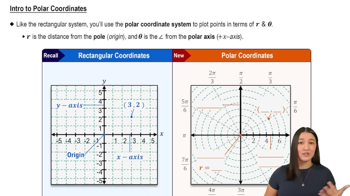
Polar coordinates represent points using a radius (r) and an angle (θ) from the positive x-axis. Polar equations express relationships between r and θ, describing curves in the plane. Understanding how to interpret and plot these equations is essential for graphing.
Video consigliato:
Percorso guidato
Intro to Polar Coordinates
Symmetry Tests in Polar Graphs
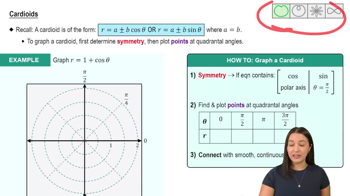
Symmetry in polar graphs can be tested about the polar axis, the line θ = π/2, and the pole (origin). These tests involve substituting θ with -θ, π - θ, or replacing r with -r to check if the equation remains unchanged, helping to predict the shape and simplify graphing.
Video consigliato:
Percorso guidato
Cardioids
Handling and Simplifying Rational Polar Equations
Polar equations like r = 1 / (1 - cos θ) often represent conic sections and require careful algebraic manipulation to analyze. Recognizing singularities (where denominator is zero) and understanding the behavior near these points aids in accurate graphing and interpretation.
Video consigliato:
Percorso guidato
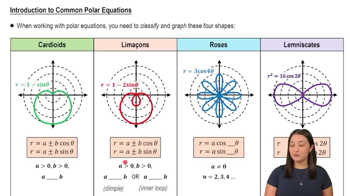
Introduction to Common Polar Equations
Pratica correlata
Domanda del libro di testo
772
views
Domanda del libro di testo
In Exercises 33–40, polar coordinates of a point are given. Find the rectangular coordinates of each point. (7.4, 2.5)
841
views
Domanda del libro di testo
In Exercises 33–40, polar coordinates of a point are given. Find the rectangular coordinates of each point. (−4, π/2)
893
views
Domanda del libro di testo
In Exercises 37–52, perform the indicated operations and write the result in standard form. __ (−2 + √−4)²
648
views
Domanda del libro di testo
In Exercises 37–52, perform the indicated operations and write the result in standard form. ___ ___ 5√−16 + 3√−81
678
views
Domanda del libro di testo
In Exercises 37–44, find the product of the complex numbers. Leave answers in polar form. z₁ = cos π/4 + i sin π/4 z₂ = cos π/3 + i sin π/3
545
views