Ch. 5 - Complex Numbers, Polar Coordinates and Parametric Equations
Blitzer - Trigonometry 3rd Edition
Blitzer3rd EditionTrigonometryISBN: 9780137316601Non è quello che usi tu?Cambia libro di testo
Capitolo 5, Problema 39

In Exercises 37–52, perform the indicated operations and write the result in standard form. ___ ___ 5√−16 + 3√−81

Guida verificata passo dopo passo
1
Recognize that the expressions involve square roots of negative numbers, which means we are dealing with imaginary numbers. Recall that \(\sqrt{-a} = \sqrt{a} \times i\), where \(i\) is the imaginary unit with the property \(i^2 = -1\).
Rewrite each term by separating the negative sign inside the square root: \(5\sqrt{-16} = 5 \times \sqrt{16} \times i\) and \(3\sqrt{-81} = 3 \times \sqrt{81} \times i\).
Calculate the square roots of the positive numbers: \(\sqrt{16} = 4\) and \(\sqrt{81} = 9\), so the expressions become \(5 \times 4 \times i\) and \(3 \times 9 \times i\) respectively.
Multiply the coefficients: \(5 \times 4 = 20\) and \(3 \times 9 = 27\), so the terms are \$20i$ and \$27i$.
Add the two imaginary terms together: \(20i + 27i = (20 + 27)i\), which simplifies to \$47i$. This is the result in standard form, where the real part is 0 and the imaginary part is \(47\).

Risposta video verificata per un problema simile:

Questa soluzione video è stata consigliata dai nostri tutor come utile per risolvere questo problema.
Durata del video:
3m

Concetti chiave

Ecco i concetti essenziali che devi comprendere per rispondere correttamente alla domanda.

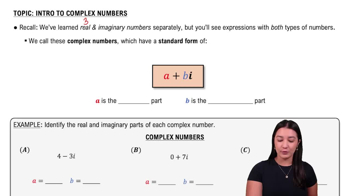
Imaginary Numbers and Complex Numbers

Imaginary numbers arise from the square roots of negative numbers, defined using the imaginary unit i, where i² = -1. Complex numbers combine real and imaginary parts in the form a + bi, allowing operations involving roots of negative numbers to be expressed in standard form.
Video consigliato:
Percorso guidato
3:31
Introduction to Complex Numbers

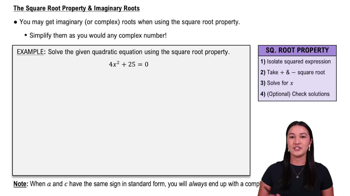
Simplifying Square Roots of Negative Numbers

To simplify the square root of a negative number, separate it into the square root of the positive part times the square root of -1. For example, √-16 = √16 × √-1 = 4i. This process converts the expression into a form involving imaginary units, facilitating further arithmetic.
Video consigliato:
Percorso guidato
2:20
Imaginary Roots with the Square Root Property

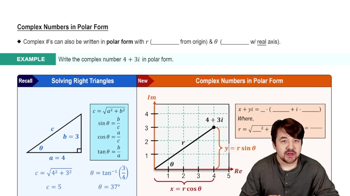
Addition of Complex Numbers and Standard Form

Adding complex numbers involves combining their real parts and imaginary parts separately. The standard form of a complex number is a + bi, where a and b are real numbers. Writing results in this form ensures clarity and consistency in representing complex expressions.
Video consigliato:
Percorso guidato
04:47
Complex Numbers In Polar Form