Ch. 5 - Complex Numbers, Polar Coordinates and Parametric Equations
Blitzer - Trigonometry 3rd Edition
Blitzer3rd EditionTrigonometryISBN: 9780137316601Non è quello che usi tu?Cambia libro di testo
Capitolo 5, Problema 41

In Exercises 41–48, the rectangular coordinates of a point are given. Find polar coordinates of each point. Express θ in radians. (−2, 2)

Guida verificata passo dopo passo
1
Recall that to convert rectangular coordinates \((x, y)\) to polar coordinates \((r, \theta)\), we use the formulas: \(r = \sqrt{x^2 + y^2}\) and \(\theta = \arctan\left(\frac{y}{x}\right)\).
Calculate the radius \(r\) by substituting \(x = -2\) and \(y = 2\) into the formula: \(r = \sqrt{(-2)^2 + 2^2}\).
Find the angle \(\theta\) by calculating \(\arctan\left(\frac{2}{-2}\right) = \arctan(-1)\), which gives a reference angle. Remember that since \(x\) is negative and \(y\) is positive, the point lies in the second quadrant.
Adjust the angle \(\theta\) to the correct quadrant by adding \(\pi\) radians if necessary, because the arctangent function alone only gives values in the first and fourth quadrants.
Express the final polar coordinates as \((r, \theta)\), where \(r\) is the positive radius found in step 2, and \(\theta\) is the angle in radians adjusted for the correct quadrant.

Risposta video verificata per un problema simile:

Questa soluzione video è stata consigliata dai nostri tutor come utile per risolvere questo problema.
Durata del video:
6m

Concetti chiave

Ecco i concetti essenziali che devi comprendere per rispondere correttamente alla domanda.

Rectangular and Polar Coordinate Systems

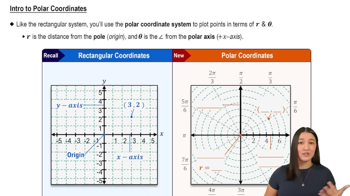
Rectangular coordinates (x, y) specify a point's position using horizontal and vertical distances from the origin. Polar coordinates (r, θ) represent the same point by its distance r from the origin and the angle θ formed with the positive x-axis, measured in radians.
Video consigliato:
Percorso guidato
05:32
Intro to Polar Coordinates

Conversion Formulas Between Coordinates

To convert from rectangular to polar coordinates, use r = √(x² + y²) to find the radius and θ = arctan(y/x) to find the angle. Adjust θ based on the quadrant of the point to ensure the angle is correctly positioned.
Video consigliato:
Percorso guidato
05:32
Intro to Polar Coordinates

Angle Measurement in Radians and Quadrant Considerations

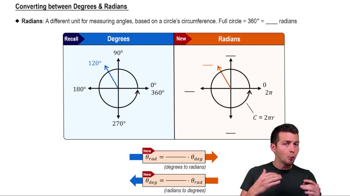
Angles in polar coordinates are measured in radians, where 2π radians equal 360°. Since arctan only returns values between -π/2 and π/2, you must consider the point's quadrant to determine the correct θ, adding π if necessary for points in the second or third quadrants.
Video consigliato:
Percorso guidato
5:04
Converting between Degrees & Radians