In Exercises 81–86, solve each equation in the complex number system. Express solutions in polar and rectangular form. x⁶ − 1 = 0
Ch. 5 - Complex Numbers, Polar Coordinates and Parametric Equations

Tutti i libri di testo
Blitzer 3rd Edition
Ch. 5 - Complex Numbers, Polar Coordinates and Parametric Equations
Problema 79
Blitzer 3rd Edition
Ch. 5 - Complex Numbers, Polar Coordinates and Parametric Equations
Problema 79Capitolo 5, Problema 79
In Exercises 79–80, convert each polar equation to a rectangular equation. Then determine the graph's slope and y-intercept.
r sin (θ − π/4) = 2
Guida verificata passo dopo passo1
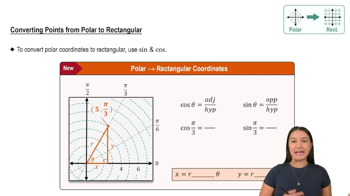
Recall the relationships between polar and rectangular coordinates: \(x = r \cos \theta\) and \(y = r \sin \theta\). Also, \(r = \sqrt{x^2 + y^2}\) and \(\tan \theta = \frac{y}{x}\).
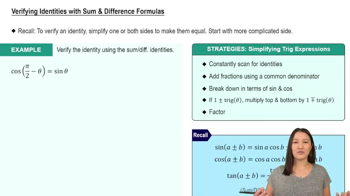
Use the angle difference identity for sine: \(\sin(\theta - \frac{\pi}{4}) = \sin \theta \cos \frac{\pi}{4} - \cos \theta \sin \frac{\pi}{4}\). Substitute this into the given equation to get \(r (\sin \theta \cos \frac{\pi}{4} - \cos \theta \sin \frac{\pi}{4}) = 2\).
Since \(\cos \frac{\pi}{4} = \sin \frac{\pi}{4} = \frac{\sqrt{2}}{2}\), rewrite the equation as \(r \left( \sin \theta \frac{\sqrt{2}}{2} - \cos \theta \frac{\sqrt{2}}{2} \right) = 2\).
Distribute \(r\) and replace \(r \sin \theta\) with \(y\) and \(r \cos \theta\) with \(x\), yielding \(\frac{\sqrt{2}}{2} y - \frac{\sqrt{2}}{2} x = 2\).
Multiply both sides by \(\sqrt{2}\) to clear the fractions, then rearrange the equation into the slope-intercept form $y = mx + b$ to identify the slope and y-intercept.

Risposta video verificata per un problema simile:
Questa soluzione video è stata consigliata dai nostri tutor come utile per risolvere questo problema.
Durata del video:
6mConcetti chiave
Ecco i concetti essenziali che devi comprendere per rispondere correttamente alla domanda.
Conversion between Polar and Rectangular Coordinates
Polar coordinates (r, θ) relate to rectangular coordinates (x, y) through the formulas x = r cos θ and y = r sin θ. Converting a polar equation to rectangular form involves substituting these expressions to rewrite the equation in terms of x and y.
Video consigliato:
Percorso guidato
Convert Points from Polar to Rectangular
Trigonometric Angle Difference Identity
The angle difference identity for sine states that sin(α − β) = sin α cos β − cos α sin β. Applying this identity to sin(θ − π/4) allows the polar equation to be expanded into terms involving sin θ and cos θ, facilitating conversion to rectangular coordinates.
Video consigliato:
Percorso guidato
Verifying Identities with Sum and Difference Formulas
Slope and Y-Intercept of a Line
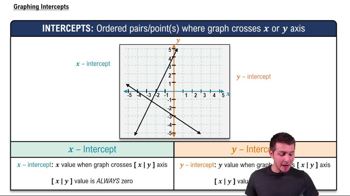
Once the equation is in rectangular form (y = mx + b), the slope (m) represents the line's steepness, and the y-intercept (b) is the point where the line crosses the y-axis. Identifying these helps in graphing and understanding the line's behavior.
Video consigliato:
Percorso guidato
Graphing Intercepts
Pratica correlata
Domanda del libro di testo
754
views
Domanda del libro di testo
Find two different sets of parametric equations for y = x² + 6.
728
views
Domanda del libro di testo
In Exercises 81–82, find the rectangular coordinates of each pair of points. Then find the distance, in simplified radical form, between the points. (2, 2π/3) and (4, π/6)
817
views
Domanda del libro di testo
In Exercises 77–80, convert to polar form and then perform the indicated operations. Express answers in polar and rectangular form.
(1 + i√3)(1 − i)) / 2√3 − 2i
484
views
Domanda del libro di testo
In Exercises 81–86, solve each equation in the complex number system. Express solutions in polar and rectangular form.
x⁴ + 16i = 0
840
views
Domanda del libro di testo
In Exercises 71–76, eliminate the parameter and graph the plane curve represented by the parametric equations. Use arrows to show the orientation of each plane curve. x = 3 + 2 cos t, y = 1+2 sin t; 0 ≤ t < 2π
770
views