Ch. 5 - Complex Numbers, Polar Coordinates and Parametric Equations
Blitzer - Trigonometry 3rd Edition
Blitzer3rd EditionTrigonometryISBN: 9780137316601Non è quello che usi tu?Cambia libro di testo
Capitolo 5, Problema 83

In Exercises 81–86, solve each equation in the complex number system. Express solutions in polar and rectangular form.
x⁴ + 16i = 0

Guida verificata passo dopo passo
1
Rewrite the equation as \(x^4 = -16i\) to isolate the term with the variable.
Express the complex number \(-16i\) in polar form. Recall that any complex number $z = a + bi$ can be written as \(r(\cos \theta + i \sin \theta)\), where \(r = \sqrt{a^2 + b^2}\) and \(\theta = \arctan(\frac{b}{a})\).
Calculate the magnitude \(r\) of \(-16i\) and find its argument \(\theta\). Note that \(-16i\) lies on the negative imaginary axis, so determine the correct angle accordingly.
Use De Moivre's Theorem to find the fourth roots of \(-16i\). The formula for the \(n\)th roots of a complex number in polar form \(r(\cos \theta + i \sin \theta)\) is given by: \(x_k = r^{1/n} \left( \cos \left( \frac{\theta + 2\pi k}{n} \right) + i \sin \left( \frac{\theta + 2\pi k}{n} \right) \right)\), where \(k = 0, 1, 2, ..., n-1\).
Calculate each root \(x_k\) for \(k = 0, 1, 2, 3\) in polar form, then convert each root to rectangular form using \(x = r \cos \theta\) and \(y = r \sin \theta\) to express the solutions as $x + yi$.

Risposta video verificata per un problema simile:

Questa soluzione video è stata consigliata dai nostri tutor come utile per risolvere questo problema.
Durata del video:
9m

Concetti chiave

Ecco i concetti essenziali che devi comprendere per rispondere correttamente alla domanda.

Complex Numbers in Rectangular and Polar Form

Complex numbers can be expressed in rectangular form as a + bi, where a and b are real numbers, and in polar form as r(cos θ + i sin θ) or re^{iθ}, where r is the magnitude and θ is the argument. Converting between these forms is essential for solving equations involving complex numbers.
Video consigliato:
Percorso guidato
03:58
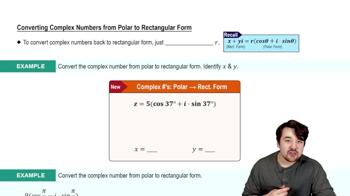
Converting Complex Numbers from Polar to Rectangular Form

De Moivre's Theorem

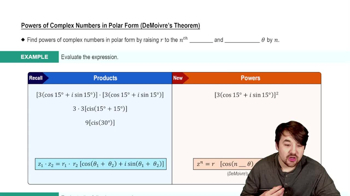
De Moivre's theorem states that for a complex number in polar form, (r(cos θ + i sin θ))^n = r^n (cos nθ + i sin nθ). This theorem is crucial for finding roots and powers of complex numbers, allowing the equation x⁴ + 16i = 0 to be solved by expressing terms in polar form and applying the theorem.
Video consigliato:
Percorso guidato
03:41
Powers Of Complex Numbers In Polar Form (DeMoivre's Theorem)

Solving Polynomial Equations in the Complex Plane

Solving polynomial equations like x⁴ + 16i = 0 involves finding all complex roots, which may be multiple and evenly spaced in the complex plane. Using polar form and De Moivre's theorem helps identify these roots by equating magnitudes and arguments, then converting solutions back to rectangular form.
Video consigliato:
Percorso guidato
7:48
Solving Linear Equations