Ch. 5 - Complex Numbers, Polar Coordinates and Parametric Equations
Blitzer - Trigonometry 3rd Edition
Blitzer3rd EditionTrigonometryISBN: 9780137316601Non è quello che usi tu?Cambia libro di testo
Capitolo 5, Problema 13

In Exercises 9–20, find each product and write the result in standard form. (7 − 5i)(−2 − 3i)

Guida verificata passo dopo passo
1
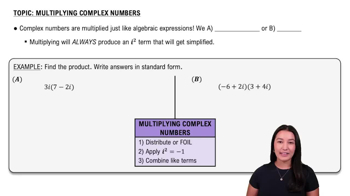
Recall that to multiply two complex numbers in the form \((a + bi)(c + di)\), you use the distributive property (FOIL method): multiply each term in the first complex number by each term in the second complex number.
Apply the distributive property to \((7 - 5i)(-2 - 3i)\): multiply \(7\) by \(-2\), \(7\) by \(-3i\), \(-5i\) by \(-2\), and \(-5i\) by \(-3i\).
Write out the products explicitly: \(7 \times (-2)\), \(7 \times (-3i)\), \(-5i \times (-2)\), and \(-5i \times (-3i)\).
Simplify each product, remembering that \(i^2 = -1\). For example, \(-5i \times -3i = 15i^2\), which can be rewritten using \(i^2 = -1\).
Combine the real parts and the imaginary parts separately to write the product in standard form $a + bi$.

Risposta video verificata per un problema simile:

Questa soluzione video è stata consigliata dai nostri tutor come utile per risolvere questo problema.
Durata del video:
3m

Concetti chiave

Ecco i concetti essenziali che devi comprendere per rispondere correttamente alla domanda.

Complex Number Multiplication

Multiplying complex numbers involves using the distributive property (FOIL method) to expand the product. Each term in the first complex number is multiplied by each term in the second, combining like terms and applying the rule i² = -1 to simplify.
Video consigliato:
Percorso guidato
5:02
Multiplying Complex Numbers

Standard Form of a Complex Number

The standard form of a complex number is expressed as a + bi, where a is the real part and b is the imaginary part. After multiplication, the result should be simplified and rearranged to clearly separate the real and imaginary components.
Video consigliato:
Percorso guidato
04:47
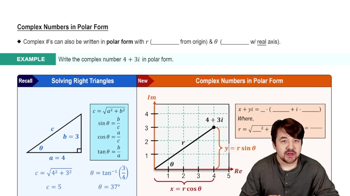
Complex Numbers In Polar Form

Imaginary Unit Properties

The imaginary unit i is defined such that i² = -1. This property is essential when simplifying products involving i, as it allows conversion of i² terms into real numbers, enabling the expression to be written in standard form.
Video consigliato:
Percorso guidato
2:20
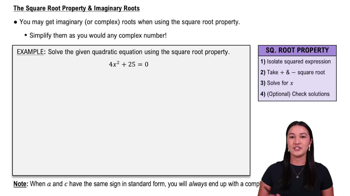
Imaginary Roots with the Square Root Property