Ch. 1 - Trigonometric Functions
Lial - Trigonometry 12th Edition
Lial12th EditionTrigonometryISBN: 9780136552161, 9780135440780, 9780136881117, 9780135440827, 9780135924891Non è quello che usi tu?Cambia libro di testo
Capitolo 2, Problema 103

Concept Check Suppose that ―90° < θ < 90° .   Find the sign of each function value. cos(θ―180°)

Guida verificata passo dopo passo
1
Recall the given range for \( \theta \): \( -90^\circ < \theta < 90^\circ \). This means \( \theta \) is in either Quadrant I or Quadrant IV.
Rewrite the expression inside the cosine function: \( \cos(\theta - 180^\circ) \). Using the cosine subtraction formula or the cosine shift identity, recognize that \( \cos(\alpha - 180^\circ) = -\cos(\alpha) \). So, \( \cos(\theta - 180^\circ) = -\cos(\theta) \).
Determine the sign of \( \cos(\theta) \) for \( \theta \) in the interval \( (-90^\circ, 90^\circ) \). Since cosine is positive in Quadrant I (0° to 90°) and positive in Quadrant IV (-90° to 0°), \( \cos(\theta) > 0 \) in this range.
Since \( \cos(\theta) > 0 \), then \( -\cos(\theta) < 0 \). Therefore, \( \cos(\theta - 180^\circ) \) is negative for \( \theta \) in the given interval.
Summarize: The sign of \( \cos(\theta - 180^\circ) \) is negative when \( -90^\circ < \theta < 90^\circ \).

Risposta video verificata per un problema simile:

Questa soluzione video è stata consigliata dai nostri tutor come utile per risolvere questo problema.
Durata del video:
2m

Concetti chiave

Ecco i concetti essenziali che devi comprendere per rispondere correttamente alla domanda.

Angle Measurement and Quadrants

Angles in trigonometry are measured in degrees or radians and are positioned within four quadrants on the coordinate plane. Knowing that θ is between -90° and 90° places it in Quadrants I or IV, which helps determine the sign of trigonometric functions based on the angle's location.
Video consigliato:
Percorso guidato
6:36
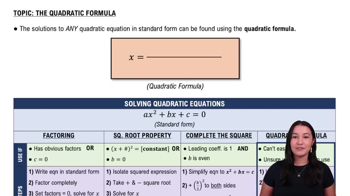
Quadratic Formula

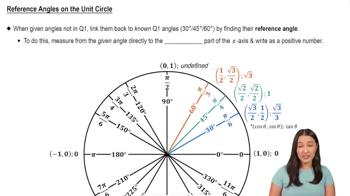
Reference Angles and Angle Transformations

Transforming an angle by adding or subtracting 180° shifts it to the opposite side of the unit circle. For cos(θ - 180°), the angle moves to a quadrant opposite to θ, affecting the sign of the cosine value due to the symmetry and periodicity of trigonometric functions.
Video consigliato:
Percorso guidato
5:31
Reference Angles on the Unit Circle

Sign of the Cosine Function in Different Quadrants

The cosine function is positive in Quadrants I and IV and negative in Quadrants II and III. Understanding which quadrant the transformed angle lies in allows us to determine whether cos(θ - 180°) is positive or negative based on the cosine sign rules.
Video consigliato:
Percorso guidato
06:14
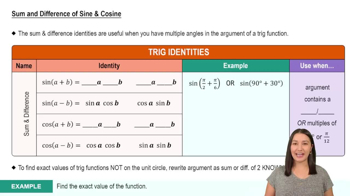
Sum and Difference of Sine & Cosine