Ch. 1 - Trigonometric Functions
Lial - Trigonometry 12th Edition
Lial12th EditionTrigonometryISBN: 9780136552161, 9780135440780, 9780136881117, 9780135440827, 9780135924891Non è quello che usi tu?Cambia libro di testo
Capitolo 2, Problema 101

Concept Check Suppose that ―90° < θ < 90° . Find the sign of each function value.
sec(―θ)

Guida verificata passo dopo passo
1
Recall the definition of the secant function: \(\sec(\theta) = \frac{1}{\cos(\theta)}\). To find the sign of \(\sec(-\theta)\), we need to understand the sign of \(\cos(-\theta)\) first.
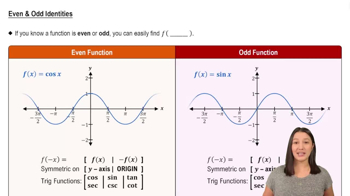
Use the even-odd property of cosine: \(\cos(-\theta) = \cos(\theta)\). This means the cosine function is even, so its value at \(-\theta\) is the same as at \(\theta\).
Since \(-90^\circ < \theta < 90^\circ\), \(\theta\) lies in the first or fourth quadrant. In both these quadrants, \(\cos(\theta)\) is positive.
Because \(\cos(\theta)\) is positive in this interval, \(\cos(-\theta)\) is also positive. Therefore, \(\sec(-\theta) = \frac{1}{\cos(-\theta)}\) will have the same sign as \(\frac{1}{\text{positive}}\), which is positive.
Conclude that \(\sec(-\theta)\) is positive for \(-90^\circ < \theta < 90^\circ\).

Risposta video verificata per un problema simile:

Questa soluzione video è stata consigliata dai nostri tutor come utile per risolvere questo problema.
Durata del video:
3m

Concetti chiave

Ecco i concetti essenziali che devi comprendere per rispondere correttamente alla domanda.

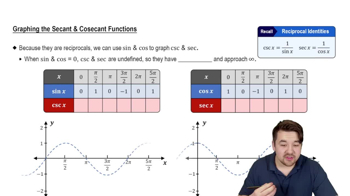
Definition and Domain of the Secant Function

The secant function, sec(θ), is defined as the reciprocal of the cosine function: sec(θ) = 1/cos(θ). It is important to understand that sec(θ) is undefined where cos(θ) = 0. Since θ is between -90° and 90°, cos(θ) is positive in this interval except at the endpoints, so sec(θ) will also be defined and its sign depends on cos(θ).
Video consigliato:
Percorso guidato
6:22
Graphs of Secant and Cosecant Functions

Even-Odd Properties of Trigonometric Functions

The cosine function is an even function, meaning cos(-θ) = cos(θ). Since sec(θ) = 1/cos(θ), sec(θ) inherits this even property: sec(-θ) = sec(θ). This property helps determine the sign of sec(-θ) by relating it directly to sec(θ) without changing the sign.
Video consigliato:
Percorso guidato
06:19
Even and Odd Identities

Sign of Cosine and Secant in the Interval -90° < θ < 90°

Within the interval -90° < θ < 90°, cosine values are positive because the angle lies in the first and fourth quadrants where cosine is positive. Since sec(θ) = 1/cos(θ), sec(θ) is also positive in this range. Therefore, sec(-θ) will have the same positive sign as sec(θ).
Video consigliato:
Percorso guidato
6:22
Graphs of Secant and Cosecant Functions