Ch. 1 - Trigonometric Functions
Lial - Trigonometry 12th Edition
Lial12th EditionTrigonometryISBN: 9780136552161, 9780135440780, 9780136881117, 9780135440827, 9780135924891Non è quello che usi tu?Cambia libro di testo
Capitolo 2, Problema 70

Convert each angle measure to degrees, minutes, and seconds. If applicable, round to the nearest second. -25.485°

Guida verificata passo dopo passo
1
Identify the given angle in decimal degrees: \(-25.485^\circ\).
Separate the angle into its degrees part and the decimal part. The degrees part is the integer portion, which is \(-25^\circ\).
Take the absolute value of the decimal part (ignore the negative sign for now) to convert it into minutes: multiply \(0.485\) by \(60\) to get the minutes.
Separate the minutes into its integer part and decimal part. The integer part is the minutes, and the decimal part will be converted into seconds by multiplying by \(60\).
Combine the degrees, minutes, and seconds, and then reapply the negative sign to the degrees to reflect the original angle's direction.

Risposta video verificata per un problema simile:

Questa soluzione video è stata consigliata dai nostri tutor come utile per risolvere questo problema.
Durata del video:
3m

Concetti chiave

Ecco i concetti essenziali che devi comprendere per rispondere correttamente alla domanda.

Decimal Degrees to Degrees, Minutes, and Seconds Conversion

This concept involves converting an angle expressed in decimal degrees into degrees, minutes, and seconds (D° M' S"). One degree equals 60 minutes, and one minute equals 60 seconds. The integer part of the decimal degree is the degrees, the decimal remainder multiplied by 60 gives minutes, and the remaining decimal part of minutes multiplied by 60 gives seconds.
Video consigliato:
Percorso guidato
5:04
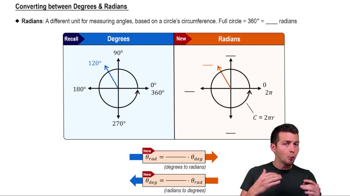
Converting between Degrees & Radians

Handling Negative Angles in Angle Conversion

When converting negative angles, the sign applies to the degrees, while minutes and seconds remain positive values. This means the angle is measured in the opposite direction, but minutes and seconds are always expressed as positive quantities to maintain clarity in the angle's components.
Video consigliato:
Percorso guidato
04:46
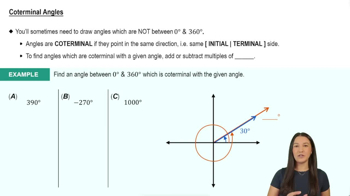
Coterminal Angles

Rounding to the Nearest Second

After calculating seconds from the decimal part of minutes, rounding to the nearest whole number is necessary for precision. This ensures the angle is expressed in a standard format, making it easier to interpret and use in further calculations or applications.
Video consigliato:
Percorso guidato
4:45
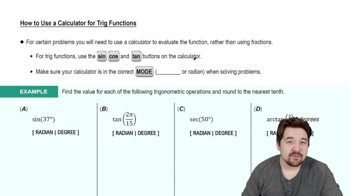
How to Use a Calculator for Trig Functions
Pratica correlata
Domanda del libro di testo

Convert each angle measure to degrees, minutes, and seconds. If applicable, round to the nearest second. See Example 4(b). 174.255°

629
views

Domanda del libro di testo

Find the indicated function value. If it is undefined, say so. See Example 4. sin(―270°)

672
views
Domanda del libro di testo

Find the indicated function value. If it is undefined, say so. See Example 4. tan 450°

640
views
Domanda del libro di testo

Convert each angle measure to degrees, minutes, and seconds. If applicable, round to the nearest second. 59.0854°

707
views
Domanda del libro di testo

Use identities to solve each of the following. Rationalize denominators when applicable. See Examples 5–7. Find cot θ , given that csc θ = ―1.45 and θ is in quadrant III.

798
views
1
rank
Domanda del libro di testo

Solve each problem. Solar Eclipse on Earth The sun has a diameter of about 865,000 mi with a maximum distance from Earth's surface of about 94,500,000 mi. The moon has a smaller diameter of 2159 mi. For a total solar eclipse to occur, the moon must pass between Earth and the sun. The moon must also be close enough to Earth for the moon's umbra (shadow) to reach the surface of Earth. (Data from Karttunen, H., P. Kröger, H. Oja, M. Putannen, and K. Donners, Editors, Fundamental Astronomy, Fourth Edition, Springer-Verlag.) a. Calculate the maximum distance, to the nearest thousand miles, that the moon can be from Earth and still have a total solar eclipse occur. (Hint: Use similar triangles.)

804
views