Ch. 1 - Trigonometric Functions
Lial - Trigonometry 12th Edition
Lial12th EditionTrigonometryISBN: 9780136552161, 9780135440780, 9780136881117, 9780135440827, 9780135924891Non è quello che usi tu?Cambia libro di testo
Capitolo 2, Problema 69

Solve each problem. Solar Eclipse on Earth The sun has a diameter of about 865,000 mi with a maximum distance from Earth's surface of about 94,500,000 mi. The moon has a smaller diameter of 2159 mi. For a total solar eclipse to occur, the moon must pass between Earth and the sun. The moon must also be close enough to Earth for the moon's umbra (shadow) to reach the surface of Earth. (Data from Karttunen, H., P. Kröger, H. Oja, M. Putannen, and K. Donners, Editors, Fundamental Astronomy, Fourth Edition, Springer-Verlag.) a. Calculate the maximum distance, to the nearest thousand miles, that the moon can be from Earth and still have a total solar eclipse occur. (Hint: Use similar triangles.)

Guida verificata passo dopo passo
1
Identify the similar triangles formed by the sun, moon, and their shadows. The sun and moon create two similar triangles: one with the sun's diameter and distance from Earth, and the other with the moon's diameter and the maximum distance from Earth where the moon's shadow just reaches Earth.
Set up the proportion using the diameters and distances. Let \(D_s = 865,000\) miles be the sun's diameter, \(d_s = 94,500,000\) miles be the sun's distance from Earth, \(D_m = 2,159\) miles be the moon's diameter, and \(d_m\) be the maximum distance from Earth to the moon for a total eclipse. The proportion is: \[\frac{D_s}{d_s} = \frac{D_m}{d_m}\]
Rearrange the proportion to solve for \(d_m\): \[d_m = \frac{D_m \times d_s}{D_s}\]
Calculate \(d_m\) using the given values to find the maximum distance the moon can be from Earth for a total solar eclipse. Remember to keep the units consistent and round the final answer to the nearest thousand miles.
Interpret the result: this distance represents the farthest the moon can be from Earth while still casting a shadow that reaches Earth's surface, allowing a total solar eclipse to occur.

Risposta video verificata per un problema simile:

Questa soluzione video è stata consigliata dai nostri tutor come utile per risolvere questo problema.

Concetti chiave

Ecco i concetti essenziali che devi comprendere per rispondere correttamente alla domanda.

Similar Triangles

Similar triangles have the same shape but different sizes, with corresponding angles equal and sides proportional. In this problem, the sun, moon, and their shadows form similar triangles, allowing us to set up ratios between their diameters and distances to find the maximum distance of the moon for a total eclipse.
Video consigliato:
Percorso guidato
5:35
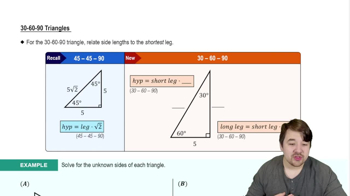
30-60-90 Triangles

Geometry of Solar Eclipses

A total solar eclipse occurs when the moon completely covers the sun as seen from Earth. This requires the moon to be close enough so its umbra (the darkest part of its shadow) reaches Earth’s surface, which depends on the relative sizes and distances of the sun and moon.
Video consigliato:
Percorso guidato
05:29
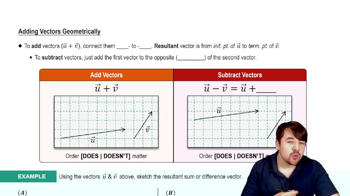
Adding Vectors Geometrically

Proportional Reasoning in Astronomy

Proportional reasoning involves using ratios to relate physical quantities. Here, the ratio of the sun’s diameter to its distance from Earth is compared to the moon’s diameter and its distance from Earth to determine the maximum moon distance for a total eclipse.
Video consigliato:
Percorso guidato
4:30
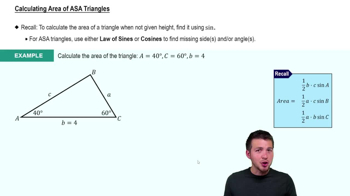
Calculating Area of ASA Triangles