Use the appropriate reciprocal identity to find each function value. Rationalize denominators when applicable. See Example 1. csc θ , given that sin θ = ―3/7
Ch. 1 - Trigonometric Functions
Lial12th EditionTrigonometryISBN: 9780136552161, 9780135440780, 9780136881117, 9780135440827, 9780135924891Non è quello che usi tu?Cambia libro di testo
Capitolo 2, Problema 12
Find the measure of each marked angle.
Guida verificata passo dopo passo1
Identify the given angles and the relationships between them, such as complementary, supplementary, vertical, or corresponding angles.
Use the appropriate trigonometric or geometric properties to set up equations. For example, if two angles are complementary, their measures add up to \(180^\circ\); if they are vertical angles, they are equal.
Express the unknown angles in terms of known angles or variables using these relationships.
Solve the resulting equations step-by-step to find the measure of each marked angle.
Verify your answers by checking that the sum of angles in relevant triangles or straight lines matches the expected total (e.g., \(180^\circ\) for a triangle, \(180^\circ\) for a straight line).

Risposta video verificata per un problema simile:
Questa soluzione video è stata consigliata dai nostri tutor come utile per risolvere questo problema.
Durata del video:
3mConcetti chiave
Ecco i concetti essenziali che devi comprendere per rispondere correttamente alla domanda.
Angle Measurement
Angle measurement quantifies the rotation between two intersecting lines or rays, typically expressed in degrees or radians. Understanding how to read and interpret angle measures is fundamental to solving problems involving marked angles.
Video consigliato:
Percorso guidato
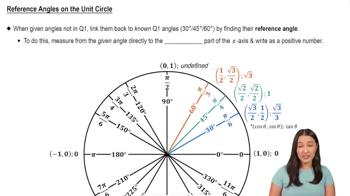
Reference Angles on the Unit Circle
Properties of Angles
Key properties such as complementary, supplementary, vertical, and adjacent angles help relate unknown angles to known ones. Recognizing these relationships allows for calculating missing angle measures using basic arithmetic.
Video consigliato:
Percorso guidato
Imaginary Roots with the Square Root Property
Trigonometric Ratios and Functions
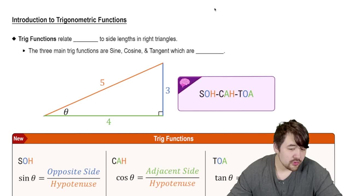
Trigonometric ratios (sine, cosine, tangent) relate angles to side lengths in right triangles. These functions are essential for finding angle measures when side lengths are known or for solving problems involving non-right triangles using laws like the Law of Sines or Cosines.
Video consigliato:
Percorso guidato
Introduction to Trigonometric Functions
Pratica correlata
Domanda del libro di testo
960
views
Domanda del libro di testo
Find the measure of each marked angle. In Exercises 19–22, m and n are parallel. See Examples 1 and 2 .
734
views
Domanda del libro di testo
Find the measure of (a) the complement and (b) the supplement of an angle with the given measure. See Examples 1 and 3. 30°
753
views
Domanda del libro di testo
Find the measure of each marked angle. In Exercises 19–22, m and n are parallel. See Examples 1 and 2 .
<IMAGE>
471
views
Domanda del libro di testo
Sketch an angle θ in standard position such that θ has the least positive measure, and the given point is on the terminal side of θ. Then find the values of the six trigonometric functions for each angle. Rationalize denominators when applicable. See Examples 1, 2, and 4. (―12 , ―5)
726
views
Domanda del libro di testo
Find the measure of each marked angle.
635
views